
Wise vs Revolut Switzerland (2026): different jobs, better together
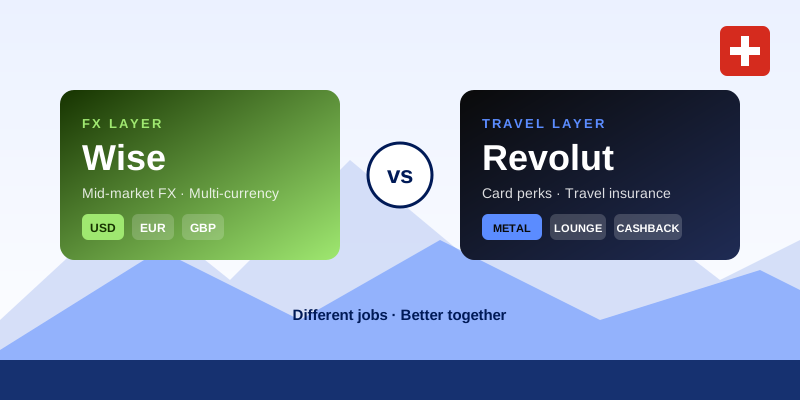
Wise is your FX layer. Revolut is your travel layer. If you have just moved to Switzerland and are trying to decide between Wise and Revolut, the cleanest answer is: stop choosing. They solve different problems. Most Swiss expats end up running both: Wise for cross-border money, Revolut for travel and daily-spend.
Published 25 May 2026 · Reviewed & updated 10 June 2026 · By bergmoney Research
Affiliate disclosure: This page links to Wise and Revolut. If you open an account through our links we may receive a referral reward at no extra cost to you. Our editorial position is not influenced by referral rewards. Read how we make money.
Short answer
Wise and Revolut are not substitutes. They are different layers of an expat finance stack: Wise is your FX layer, Revolut is your travel layer.
- Wise: predictable cross-border FX. Always mid-market, transparent fee, no monthly cap, no weekend surcharge, multi-currency receiving. Designed as transfer infrastructure.
- Revolut: consumer card ecosystem. Travel insurance, lounge-related perks, cashback, slick daily-spend card. Designed as a subscription-bundled lifestyle product.
For most expats in Switzerland, the right answer is both, each one used for what it actually does best. Add a Swiss-licensed CH-IBAN account (Alpian, Yapeal, Neon or Yuh) as the third leg. For the full framework, see our Alpian vs Revolut vs Wise comparison and best bank for foreigners in Switzerland guide.
On this page
- Quick decision (by user profile)
- TL;DR side-by-side
- Regulatory + safety reality check
- What Wise actually does best
- What Revolut actually does best
- FX showdown: the central question
- Wise Business vs Revolut Business
- Travel showdown
- Send money home scenarios
- Salary, Krankenkasse, Swiss life
- Swiss bills reality check
- When to skip one of them
- The "use both" stack
- FAQ
- Final verdict
Quick decision (by user profile)
-
"I mostly send money home or work with international clients"
Wise first. Add Revolut later only if you also travel.
-
"I travel constantly for work and want premium card perks"
Revolut Premium or Metal first. Add Wise for larger cross-border transfers.
-
"I do both regularly"
Both. Wise for the FX layer, Revolut as the daily-spend card.
-
"I only need cheap CHF daily banking in Switzerland"
Neither. Open a Swiss-licensed account (Neon or Yapeal Free) instead.
TL;DR side-by-side
| Dimension | Wise | Revolut |
|---|---|---|
| Regulatory profile | Safeguarded e-money institution | EU licensed bank (Lithuania) |
| CH IBAN | ❌ non-Swiss local-format account details | ❌ non-Swiss IBAN by default |
| Deposit protection | EMI safeguarding (no classical deposit insurance) | Lithuanian EU DGS up to EUR 100,000, not esisuisse |
| Multi-currency hold | 40+ currencies | 30+ currencies |
| Local receiving details | US ACH, UK sort code, EU IBAN, AUD BSB, others | Limited to default IBAN setup |
| FX pricing | Always mid-market + transparent fee | Free under monthly cap; markup + weekend surcharge commonly apply above |
| Weekend FX | Same pricing as weekday | Weekend surcharge commonly applies |
| Cashback | ❌ | ✅ on paid plans |
| Travel insurance | ❌ | ✅ on Premium / Metal / Ultra (terms vary) |
| Lounge-related perks | ❌ | Depending on plan and eligibility; verify current terms |
| Self-directed investing | ❌ | ✅ (basic, in-app) |
| Business account | ✅ Wise Business, strong | Revolut Business: separate apply, Swiss availability varies |
| Free tier | ✅ transfer-based | ✅ Revolut Standard |
| Best at | Predictable cross-border FX at any volume | Travel-card + daily-spend bundle |
Benefits and pricing terms change over time; verify current plan terms on each provider's website.
Regulatory + safety reality check
IBAN reality
Neither Wise nor Revolut issues a CH IBAN. Wise commonly provides non-Swiss local-format account details depending on the currency (examples: US ACH for USD, UK sort code for GBP, an EU IBAN for EUR). Revolut typically issues a non-Swiss IBAN by default. Specific account-details setup on either side depends on currency and region, so check in-app for what you actually receive.
In Switzerland, salary, Krankenkasse direct debit, rent direct debits, QR-bill payments and the annual Steuerausweis tax-statement workflow typically run on CH-prefixed IBANs. Foreign IBANs are commonly rejected by Swiss payroll systems and Krankenkasse providers. For most expats, neither Wise nor Revolut works best as the only Swiss financial account.
This is not a defect; it is what they are. Neither product was designed to replace a Swiss bank.
Safety reality
The deposit-protection picture is different for each.
- Wise is a safeguarded e-money institution. Customer funds sit in segregated safeguarding accounts at partner banks. This is not classical deposit insurance; there is no scheme equivalent to esisuisse for Wise balances.
- Revolut in Switzerland operates under EU passporting via Revolut Bank UAB (Lithuania). Customer deposits sit under the Lithuanian EU Deposit Guarantee Scheme up to EUR 100,000 per client. Real deposit insurance, but Lithuanian, not Swiss.
- Neither is covered by esisuisse (the Swiss CHF 100,000 scheme), which only applies to fully-licenced Swiss banks.
Practical takeaway: keep large idle CHF savings at a fully-licenced Swiss bank (Alpian, UBS, Raiffeisen, PostFinance, cantonal). Use Wise and Revolut for transactional money and the specific jobs they each do well.
What Wise actually does best
Wise is transfer infrastructure packaged as a consumer app. Its core competency is moving money across borders with predictable, mid-market pricing, at any volume, every day of the week.
-
Always mid-market FX + transparent fee
No hidden margin, no plan-dependent pricing, no surcharge for weekends or large amounts. Same rate Monday or Sunday.
-
Multi-currency receiving with local-format details
Receive USD via US ACH, GBP via UK sort code, EUR via a European IBAN, AUD via local BSB, and more. Magic for cross-border freelancers and Swiss expats receiving income from abroad.
-
Wise Business
Batch payouts, accounting integrations (Xero, QuickBooks, Sage), team access with roles, multi-currency receiving for freelancers and GmbHs. One-off setup fee, no monthly subscription cost.
-
Transparent fee structure
Every transfer shows the exact fee + the exact mid-market rate before you confirm. No surprises.
-
No subscription needed
The free Wise Personal account already gets the full mid-market FX engine. Upgrades are optional and minimal.
Where Wise stays in its lane: no travel insurance, no lounge perks, no cashback, no investing. Wise does not try to be a lifestyle product. That is the entire point.
Deep dive: Wise Switzerland review.
What Revolut actually does best
Revolut is a consumer card ecosystem sold through paid subscription tiers. Its core competency is bundling travel and daily-spend perks into one app, plus delivering a slick everyday card experience.
-
Travel insurance + lounge-related perks
Revolut paid plans bundle travel insurance and (on Metal/Ultra) lounge-related perks. For frequent travellers, this often pays back the subscription on its own.
-
Cashback on paid plans
Plus, Premium, Metal and Ultra offer cashback on card spend (rates and caps depend on plan and region, so verify in-app).
-
Slick daily-spend card
Fast push-notification transactions, freezable in one tap, virtual cards for online shopping, in-app management of categories and limits.
-
Free FX up to a monthly cap
Revolut Standard gives you mid-market FX up to a monthly free allowance, which is enough for casual travel use. Above the cap or on weekends, a markup commonly applies.
-
Built-in self-directed investing
Basic in-app investing (stocks, crypto, gold) for tiny experimental amounts. Not a serious broker, but enough to learn.
-
Peer-to-peer transfers
Instant between Revolut users, useful for splitting bills with travel companions or friends already on the platform.
Where Revolut stays in its lane: Revolut Standard's FX is not predictable at high volume or on weekends. For systematic transfers, the model breaks down.
Deep dive: Revolut Switzerland review.
FX showdown
This is the comparison most readers actually search. The short answer is that it depends on amount, day of week, and your Revolut plan tier. Pricing terms on both sides change, so what matters is the pattern, not yesterday's exact numbers.
| Scenario | Wise | Revolut |
|---|---|---|
| Weekday, under plan FX allowance | Mid-market + transparent fee | Often cheaper (free under cap on Standard) |
| Weekend conversion | Same fee logic, no weekend surcharge | Weekend markup commonly applies |
| Over plan FX allowance | Same fee logic, no allowance cliff | Markup commonly applies above cap |
| Large transfer (any day) | Often more predictable | Depends on plan limits and current pricing |
| Frequent multi-currency receiving | Local-format details in many currencies | Limited to default IBAN setup |
Actual results depend on the live exchange rate and current plan limits at the time of conversion. Verify current Wise fee and Revolut plan terms in each app.
What this means in practice
- For one-off larger transfers (rent abroad, foreign salary, sending money home): Wise is often more predictable. Same fee structure every day, at any volume.
- For small casual daily-spend abroad (Friday Berlin trip tap-to-pay): Revolut Standard under the free FX cap can be very competitive.
- For weekend tap-to-pay over the cap: Revolut Standard adds markup plus a weekend surcharge. Wise is often cheaper.
- For freelancers receiving foreign income systematically: Wise wins clearly. Local-format receiving details let you appear as a local account to payers.
Bottom line: if your cross-border money movement is regular or large, Wise is often the safer default. If it is occasional small-spend on travel under the cap, Revolut Standard usually wins. Many Swiss expats route different transactions through whichever app gives the better outcome that day. For the full method comparison on one currency pair, see the best way to convert EUR to CHF.
Wise Business vs Revolut Business
If you are running a Swiss freelance practice, sole proprietorship (Einzelfirma), GmbH or AG, the business-account question gets sharper.
Wise Business: the cross-border freelance default
- One-off setup fee, no monthly subscription.
- Multi-currency receiving in 9+ currencies with local-format details (US ACH for USD invoices, UK sort code for GBP, EU IBAN for EUR). Clients pay you locally, you hold the currency, you convert when needed at mid-market.
- Accounting integrations with Xero, QuickBooks, Sage.
- Team access with roles for bookkeepers and accountants.
- Batch payouts to international contractors.
- Clear default for Swiss freelancers and GmbHs invoicing international clients.
Revolut Business: separate apply, verify CH availability
- Separate product from Revolut Personal, with a different signup, different fees, different limits.
- Swiss availability for Revolut Business has varied over time; verify the current onboarding flow for Swiss residents and Swiss entities on the Revolut Business website before assuming it fits your CH-resident GmbH or AG structure.
- Where supported: currency-spend card for company expenses, in-app expense management, accounting integrations.
- Strongest case for it: you are already deep in the Revolut Personal ecosystem and want a unified spend card.
Practical verdict: for Swiss freelancers and GmbHs invoicing internationally, Wise Business is the default. Pair it with a Swiss-licenced business account (Yapeal Business is the strongest standalone option) for CHF invoicing, MWST, AHV/IV/EO/ALV, and QR-bill workflow. Revolut Business is optional.
For the full Swiss business banking framework (Einzelfirma / GmbH / AG / Sperrkonto / 2-account stacks) see our best business account in Switzerland pillar.
Travel showdown
This is where Revolut wins clearly. Revolut is your travel layer.
| Travel feature | Wise | Revolut |
|---|---|---|
| Travel insurance | ❌ | ✅ on paid plans (terms vary) |
| Lounge-related perks | ❌ | Depending on plan and eligibility; verify current terms |
| Cashback on card | ❌ | ✅ on paid plans |
| Hold currencies for upcoming trip | ✅ 40+ | ✅ 30+ |
| Free FX on card abroad | Always mid-market + small fee | Free under monthly cap; markup + weekend surcharge over |
| Card delivery to Switzerland | ✅ | ✅ |
Revolut updates plan benefits over time, so check current plan terms in the Revolut app before subscribing.
If you travel more than a few times per year, a Revolut paid plan typically pays back its subscription via insurance alone, and the daily-spend perks are a bonus.
Wise still has a legitimate role even for travellers: often the cheapest reliable way to load a card-friendly currency before a big trip, especially when amounts exceed Revolut's free FX cap or fall on a weekend.
Common expat setup: Revolut Metal as the primary travel card + Wise as the "top-up large amounts" tool when you need to pre-load a non-CHF balance.
Send money home scenarios
-
Eurozone (DE, IT, FR, ES, …)
Wise by default: predictable, broad bank coverage. Revolut wins only Revolut-to-Revolut peer transfers.
-
UK (GBP)
Wise wins for predictable transfers to UK accounts via UK sort code. Revolut also supports, with the standard FX cap caveats.
-
US (USD)
Wise gives you US bank account details, very useful for receiving USD income. Sending USD: Wise direct to US ACH is well-priced.
-
Ukraine (UAH)
Corridor support varies. Wise historically more transparent for UA corridors. Verify both in-app at the time of transfer.
-
Russia / Belarus
Corridor support heavily restricted since 2022 sanctions. Verify in-app, since these corridors change frequently.
-
Asia (IN, PH, SG, …)
Wise has broad direct corridor coverage. Revolut typically narrower.
Pattern: for systematic sending-home use, Wise is the safer choice. For peer-to-peer transfers between Revolut users in any country, Revolut is instant and free.
Salary, Krankenkasse, and the rest of Swiss life
Neither Wise nor Revolut is a Swiss bank, and neither is typically suited as your only account in Switzerland.
- Swiss salaryMany Swiss employers still prefer or require a Swiss IBAN for salary payments, even though IBAN-discrimination rules exist in parts of Europe. In practice, foreign IBANs are often rejected or create payroll friction. Verify with your specific HR before relying on it.
- Krankenkasse direct debitKrankenkasse providers commonly require a CH IBAN for direct debit setup.
- Rent direct debitVaries by landlord; CH IBAN is the safe assumption.
- QR-bill payments at volumeQR-bill workflow outside Swiss-licenced banks is limited and slow.
- Annual tax (Steuerausweis)A Swiss-licensed bank typically produces the consolidated tax statement; Wise/Revolut typically do not.
Plan to open a Swiss-licensed (or partner-licensed) account for Swiss-system tasks: Alpian (FINMA bank + esisuisse), Yapeal (Swiss FinTech licence, CH IBAN), Neon (cheapest CHF daily), Yuh (CH IBAN + investing). For the full framework, see best bank for foreigners in Switzerland.
Swiss bills reality check
A small but important Swiss-specific note that often gets missed in international fintech reviews.
- QR-billsThe standard Swiss payment slip with the embedded QR code on rent, utilities, insurance and taxes works materially better with a Swiss primary account. Native scan-and-pay flows live in Swiss-bank apps.
- Recurring Swiss paymentsKrankenkasse monthly direct debit, rent, mortgage and tax instalments are smoother with a Swiss CH-IBAN account on file.
- SteuerausweisSwiss tax offices expect the year-end consolidated tax statement generated by Swiss-licenced banks. Manually reconciling Wise or Revolut activity for Swiss tax filing is doable but tedious.
- TWINTSwitzerland's dominant peer-payment system. Native support depends on having a Swiss-banked account or card. Wise and Revolut work around this differently and integration evolves.
Translation: Wise and Revolut can absolutely live alongside a Swiss bank, but they are not designed to handle Swiss recurring-bill life. Health insurance, rent, taxes and QR-bill workflow run more smoothly with a Swiss-licensed account as the home base. This is one of the strongest reasons most Swiss expats end up with three accounts, not two.
When to skip one of them
Skip Wise if
You almost never send money internationally. Your salary is CHF and stays CHF. You travel rarely and do not hold non-CHF currencies. You are happy paying a Swiss bank's foreign-transfer fees on the rare occasion.
Skip Revolut if
You travel rarely (few trips per year). You do not want a paid subscription. You do not need travel insurance or cashback. Your daily-spend card is already a low-fee Swiss neobank card (Neon, Yuh).
Skip both if
You only want the cheapest possible CHF daily-banking account in Switzerland. In that case, Neon alone is enough.
The "use both" stack
For the typical Swiss expat with international roots and at least occasional travel, the cleanest setup is three accounts in clear roles:
- Wise: the cross-border FX layerSending money home, receiving foreign income, moving relocation funds at mid-market, freelance multi-currency invoicing. Wise is your FX layer.
- Revolut: the travel-and-daily-spend layerSubscription card with insurance and lounge-related perks, cashback on everyday spend, in-app peer transfers. Revolut is your travel layer.
Optional fourth layer for crypto holders: Tangem for hardware self-custody. For the full four-layer model with Alpian explicitly added as the Swiss banking core, see our Alpian vs Revolut vs Wise comparison. For the broader pillar guide, see best bank for foreigners in Switzerland.
Frequently asked questions
Wise vs Revolut: which has better FX rates?+
Different pricing models. Wise is always mid-market with a transparent fee, weekday or weekend. Revolut Standard is mid-market under a monthly free FX cap; over the cap or on weekends, a markup plus weekend surcharge commonly applies. For one-off larger transfers, Wise is typically more predictable. For small casual card-spend under the cap, Revolut Standard is often free of FX margin. Wise is your FX layer; Revolut is your travel layer. Different jobs.
Is Wise cheaper than Revolut?+
For systematic or large cross-border transfers, yes. For small casual daily card-spend under Revolut's free FX cap, Revolut Standard is typically cheaper (often free). Many expats use the right tool per transaction.
Does Revolut charge weekend fees?+
A weekend markup commonly applies to Revolut FX conversions outside the free monthly allowance. The exact percentage and which currencies it applies to evolve, so check current plan terms in the Revolut app. Wise has no weekend surcharge; pricing is the same Monday or Sunday.
Can I use both Wise and Revolut?+
Yes, and most Swiss expats do. They solve different problems. Wise for the cross-border FX layer, Revolut for the travel and daily-spend layer. Pair both with a Swiss-licensed CH-IBAN account.
Is Wise or Revolut safer for large CHF deposits?+
Different protection models. Revolut operates under the Lithuanian EU Deposit Guarantee Scheme up to EUR 100,000 per client (via Revolut Bank UAB). Wise is a safeguarded e-money institution with segregated client funds, which is not classical deposit insurance. Neither is covered by esisuisse (the Swiss CHF 100,000 scheme). For large idle CHF, keep the bulk at a fully-licensed Swiss bank (Alpian or a legacy bank) and use Wise/Revolut for transactional money.
Which is better for sending money to Ukraine?+
Corridor support and pricing for UA have evolved. Wise has historically been more transparent for UA corridors. Verify current corridor terms in both apps before sending. Foreign-exchange and corridor availability change.
Wise Business or Revolut Business for a Swiss GmbH?+
Wise Business is typically the default for cross-border freelance and international invoicing: multi-currency receiving with local-format details, accounting integrations, batch payouts. Revolut Business has a separate apply and Swiss availability varies; usually a fit only if you are already deep in the Revolut ecosystem and want a unified spend card. Pair either with a Swiss-licensed business account (Yapeal Business is strong) for CHF invoicing, MWST, AHV.
Wise debit card vs Revolut Metal?+
Different products. The Wise debit card is a transactional card paired with the multi-currency holding account; minimal perks. Revolut Metal is a subscription tier with travel insurance, lounge-related perks, cashback, premium card design. If you want perks, Metal. If you want transactional simplicity at mid-market FX, Wise.
Can I receive my Swiss salary on Wise or Revolut?+
Often not. Many Swiss employers still prefer or require a Swiss IBAN for salary payments, even though IBAN-discrimination rules exist in parts of Europe. In practice, foreign IBANs are commonly rejected or create payroll friction. Some employers accept foreign IBANs, so verify with your specific HR before relying on it. Plan to open a Swiss-licensed (or partner-licensed) account for salary deposit.
Do I need both Wise and Revolut?+
Depends on your life. If you transfer money internationally regularly AND travel often, yes, because they solve different problems. If you only do one (say, only travel), one of them is enough.
Is Revolut Premium worth it if I already have Wise?+
If you travel more than a few times per year, the travel insurance bundled in a Revolut paid plan often pays back the subscription on its own. Lounge access on Metal is the deciding factor for frequent travellers. If you never travel, paid plans are overkill, so stay on free Revolut Standard or skip Revolut entirely.
Can Ukrainians in Switzerland open both Wise and Revolut?+
Yes. Both accept Ukrainian passports plus Swiss residency documents (including Permit S). Verify the current onboarding flow in each app.
Do I still need a Swiss bank if I have Wise and Revolut?+
For most expats, yes. Swiss salary, Krankenkasse direct debit, QR-bill payments at volume, rent direct debits and the annual Steuerausweis typically run more smoothly with a Swiss-licensed CH-IBAN account. Wise and Revolut are best used as complementary layers (Wise for cross-border FX, Revolut for travel and daily-spend) alongside a Swiss banking core.
Final verdict
The premise of "Wise vs Revolut" assumes they are competing for the same job. They are not. Wise is your FX layer. Revolut is your travel layer.
- Wise is transfer infrastructure. Cross-border FX, multi-currency receiving with local-format details, freelance business banking. Predictable, always mid-market, no weekend penalty, no subscription needed.
- Revolut is a consumer card ecosystem. Travel insurance, lounge-related perks, cashback and a slick daily-spend card, sold through paid subscription tiers.
If your life involves regular cross-border money movement, open Wise first. If your life involves frequent travel, open Revolut Premium or Metal first. If both, open both, in either order.
And whatever else you do, open a Swiss-licensed CH-IBAN account as the primary financial home. Neither Wise nor Revolut typically replaces a Swiss bank for salary, Krankenkasse, QR-bills or Steuerausweis. See best bank for foreigners in Switzerland for the full framework.
Open the right ones for you
Each affiliate link costs nothing extra and supports our editorial work · disclosure
Published 25 May 2026 · Reviewed & updated 10 June 2026 by bergmoney Research.
Spotted an outdated detail or a regulatory change? Tell us. We update comparison guides quarterly.