
Tangem Wallet: the easiest way to carry your crypto savings into Switzerland, without a seed phrase
A practical review of Tangem Wallet for expats in Switzerland and for anyone who already holds crypto and wants to take it off an exchange. Why card-form hardware wallets quietly solved the seed-phrase problem, why this matters when you cross borders, and what the 10% discount through our link actually saves you.
Published 25 May 2026 · Reviewed & updated 10 June 2026 · By bergmoney Research
Affiliate disclosure: This page contains an affiliate link. If you buy a Tangem Wallet through our link, you get 10% off your purchase and we receive a small referral commission at no extra cost to you. Our editorial position is not influenced by commission rates. Read how we make money.
Editorial note on crypto coverage: This is a review of hardware self-custody storage, not a recommendation to buy or trade cryptocurrency. If you already own crypto on an exchange (Revolut, Coinbase, Binance, Kraken) or in a hot wallet, the question is how to store it safely, not whether to own it. This article answers that, nothing more. We do not provide investment advice. Crypto markets are volatile and self-custody comes with responsibilities: you are your own bank.
Short answer
Yes, Tangem Wallet is the easiest hardware wallet on the market, especially for crypto holders who are moving to or already living in Switzerland. It is a credit-card-sized chip you tap to your phone via NFC to sign transactions. No USB cable, no seed phrase to write down on paper, no fragile screen. The private key is generated on the chip and never leaves it.
For an expat carrying crypto savings across borders, this is the lowest-friction option available. Pair it with a Wise account for fiat money flow and a Swiss bank for everything else, and you have crypto, fiat and Swiss banking all separated cleanly.
Quick verdict
Tangem Wallet sits in an interesting niche. It is much easier to use than Ledger or Trezor (no seed-phrase write-down, no USB tethering, NFC tap-to-sign on your phone), but it is also a different security model from traditional hardware wallets, so it suits some users better than others.
- Expats moving to Switzerland with crypto savings
- First-time hardware-wallet users avoiding seed phrases
- Users leaving custodial exchanges (Revolut, Coinbase, Binance, Kraken)
- Frequent travellers needing ultra-portable storage
- People wanting simple self-custody without technical setup
- You do not hold crypto
- You prefer classic seed-phrase (12 / 24 words) systems
- You want a screen for transaction verification
- You expect trading or investing features
One-time purchase · 10% discount through our link
Already hold crypto on an exchange?
A hardware wallet is the single biggest security upgrade you can make. Tangem Wallet with our link is 10% off.
What Tangem actually is
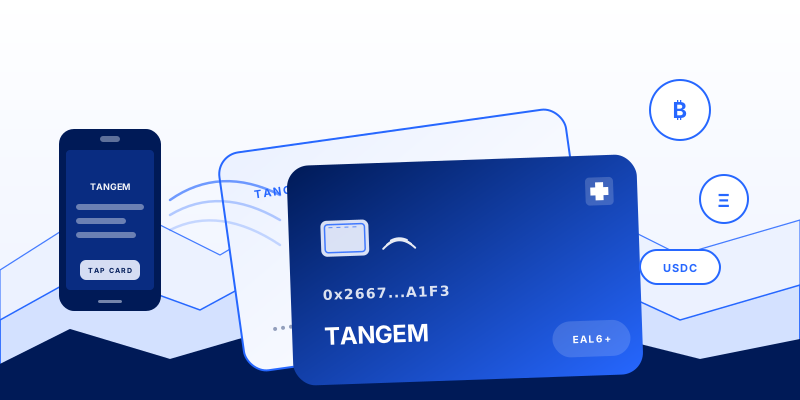
Tangem is a hardware self-custody wallet in the form of a smart card. Physically it looks like a contactless bank card. Functionally it is a secure chip (an EAL6+ certified element) that generates and holds a private key for your crypto, and signs transactions using that key without the key ever leaving the chip.
You interact with the card by tapping it to your NFC-enabled phone, which runs the Tangem app. The app shows balances, builds transactions, and asks the card to sign them. The card never connects to the internet directly. The private key never leaves the card. The phone is just a UI.
The product is sold in sets of 2 or 3 cards. The cards in a set share the same wallet, so if one card is lost or destroyed, you can still access your crypto with a backup card. The backup cards are the recovery mechanism, replacing what other hardware wallets call a "seed phrase".
Tangem AG is a Swiss-incorporated company based in Zug; the chip used in the card is manufactured to Tangem's specification by certified semiconductor partners and the firmware is audited by independent security labs (notably Kudelski Security).
How Tangem works: NFC tap, backup cards, no seed phrase
The mental model is simple.
The private key lives on the chip
The chip itself generates the private key when you first activate the card. The key is mathematically generated inside the chip's secure element. It never leaves the chip, not during activation, not during signing, not during recovery. The chip has no USB port and no way to export the key in plain text.
You sign by tapping
When you want to send crypto, you build the transaction in the Tangem app on your phone. The app sends the unsigned transaction bytes to the card via NFC. The chip signs them with the private key. The signed transaction comes back to the phone, which broadcasts it to the relevant blockchain. The phone never sees the private key. A compromised phone cannot steal your funds without your physical card.
Backup cards replace the seed phrase
In a traditional hardware wallet (Ledger, Trezor), recovery is a 12 or 24-word phrase you must write down and protect for the lifetime of the wallet. Lose the phrase and lose the wallet.
In Tangem, recovery is another physical card, a sibling card from the same set, paired during initial setup. You typically buy a 2-card or 3-card pack. Keep one card with you, hide the second in a fireproof location (home safe, parents' house, bank deposit box). If the first card is lost or destroyed, the backup card has the same wallet keys and continues to work.
Newer Tangem firmware also supports an optional export to a standard BIP-39 seed phrase, which lets you migrate to any other wallet later, but you do not have to use it. The default flow stays card-only.
Why Tangem matters for expats moving to Switzerland
This is the angle that does not get talked about enough.
If you are relocating to Switzerland from Ukraine, Russia, Belarus, Turkey, Argentina, Lebanon, Nigeria, or any country where banking has been unreliable, you very likely hold at least some crypto. Bringing it to Switzerland is not the same as bringing fiat. A custodial exchange may freeze your account during a move. A USB hardware wallet is conspicuous. A written seed phrase is a vulnerability. A hot wallet on your phone is exposed.
-
Looks like a normal payment card
No visible 'crypto device' during travel. Contactless-card form factor passes through any border crossing without flagging.
-
No paper seed phrase to protect
Nothing to write down, photograph, or accidentally leave behind. The private key never exists outside the chip in human-readable form.
-
Easy cross-border carry strategy
Send a backup card ahead by courier to your new Swiss address. Bring one card in your wallet. Mail another to a trusted family member.
-
No USB cable, no battery to fail
NFC-only. Works with any modern phone. Nothing to plug in, nothing to charge, nothing to update over the air without your physical tap.
For expats arriving in Switzerland with non-trivial crypto holdings, this is the cleanest carry-strategy available. Once in Switzerland, Tangem sits alongside your Wise account (cross-border fiat), your Swiss neobank (CHF daily banking) and your Revolut account (travel-card spending). Each tool does what it does best.
Tangem vs the traditional seed-phrase model
This is the question every existing crypto holder will ask: is Tangem really as secure as a Ledger or Trezor with a 24-word backup? The short answer is different, not worse.
Traditional model (Ledger, Trezor, Coldcard)
- 12 or 24 BIP-39 mnemonic words generated at setup
- You must write them down on paper or stamp them into metal
- You must protect those words for the lifetime of the wallet
- Recovery on any compatible wallet anywhere in the world
- Single point of failure: the phrase
Tangem model
- Private key generated on the chip; no human-readable backup by default
- Recovery via additional cards from the same set
- Recovery is physical and geographic (cards hidden in different places)
- Single point of failure: losing all cards in the set
- Optional BIP-39 export in newer firmware if you want to migrate later
Both models can be done safely. Both models can be done badly. The Tangem model removes the "I wrote the phrase down somewhere and now I cannot find it" failure mode and replaces it with the "I lost all my backup cards" failure mode. Most people find the cards easier to secure than a long string of arbitrary words.
Setup we recommend: Tangem + Wise + Swiss bank
Tangem is one piece of an expat financial setup, not the whole thing.
A Swiss bank covers Swiss life, Wise covers cross-border fiat, Tangem covers crypto self-custody, and Revolut is optional for a travel-card.
-
Swiss neobank or Swiss bank
Salary, Krankenkasse, QR-bills, rent. CH IBAN. See our Yapeal review for one option.
-
Wise
Cross-border money flow, multi-currency holding, transferring fiat between countries.
-
Tangem Wallet
Self-custody for any crypto you already hold or plan to hold.
-
Revolut (optional)
Travel-card and consumer fintech features.
Tangem solves a problem none of the other three solve: secure self-custody for the crypto portion of your wealth. Without it, your crypto sits on a custodial platform that can be hacked, frozen or sanctioned.
Pricing and what 10% off means in francs
Tangem is a one-time purchase, not a subscription.
Pack pricing changes periodically. Always verify current pricing on tangem.com before ordering.
A typical Tangem Wallet set is sold in a 2-card or 3-card pack. Approximate pricing on the standard product line (as of publication):
- 2-card pack: around CHF 50-70 depending on shipping and active promotions
- 3-card pack: around CHF 70-90
Through our referral link, you get 10% off the purchase. On a 3-card pack this is typically around CHF 7-9. Not life-changing money, but it covers shipping, and the discount applies on top of any active Tangem promotion in most cases.
For context, a Ledger Nano S Plus is roughly CHF 80; a Trezor Model One starts around CHF 70; a Trezor Model T is roughly CHF 220. Tangem sits in the mainstream-hardware-wallet price range, and the 10% off brings the 3-card set to the cheapest cost per "device" in the set.
There are no ongoing fees. You buy the card, the cards last the lifetime of the chips (decades), and Tangem makes no money from you after the purchase.
One purchase, lifetime use, no subscription.
Through our link Tangem Wallet is 10% off.
Supported coins and tokens
Tangem supports a broad set of native chains plus ERC-20, BEP-20, TRC-20 and other token standards. Without listing every line (the list changes over time), the major ones include:
- Bitcoin (BTC) and Bitcoin Cash (BCH)
- Ethereum (ETH) and all ERC-20 tokens (USDT, USDC, DAI, LINK, UNI, etc.)
- Solana (SOL) and SPL tokens
- BNB Smart Chain (BSC) and BEP-20 tokens
- Tron (TRX) and TRC-20 tokens (notably TRC-20 USDT)
- Polygon (MATIC), TON, XRP, Cardano (ADA), Polkadot (DOT), Avalanche (AVAX)
- Litecoin (LTC), Dogecoin (DOGE)
- Tens of thousands of tokens across the supported chains
For the latest authoritative list, check the Tangem app directly, since new chains and tokens are added regularly through firmware updates.
If you specifically hold an obscure altcoin, always verify support before buying the card. The Tangem website has a searchable supported-asset list.
Security, audits and the company behind it
Tangem is a Swiss-incorporated company (Tangem AG, Zug) with operations across Asia and Europe.
- EAL6+ certified secure element (same tier as passport chips and banking smartcards)
- Firmware audited by Kudelski Security, with public audit reports available
- No remote attack surface: NFC-only, no USB, no battery, no daemon
- Open-source mobile app, verifiable on GitHub
- Private key generated on the chip and never leaves it
What this does not protect you from:
- Physical theft of all cards: if an adversary obtains every card in your set, they can transfer your crypto. Geographic separation matters.
- Social engineering: nobody can extract the private key from the card, but anyone can be tricked into voluntarily signing a malicious transaction. This is the same risk as any wallet.
- Supply-chain tampering: buy directly from Tangem (or through our link, which goes to Tangem). Do not buy second-hand or from third-party marketplaces.
For most users, this security profile is far better than leaving crypto on a custodial exchange.
Tangem vs Ledger
The most common comparison.
Ledger advantages
- Standard 12 / 24-word seed phrase (portable to any compatible wallet)
- Larger product line (Nano S Plus, Nano X, Stax)
- Largest market share, established brand
- Built-in screen on some models
Tangem advantages
- No seed phrase required
- Card form factor that fits in a wallet, no USB cable
- NFC tap-to-sign is faster than USB
- Backup via physical cards instead of paper / metal
- Easier onboarding for non-technical users
Ledger suits advanced users who want seed-phrase portability and a built-in screen. Tangem suits users who want self-custody without the seed-phrase ceremony, and anyone with a strong portability need (frequent travel, cross-border relocation).
A dedicated Ledger review is in our pipeline and will be linked here when published.
Tangem vs Trezor
Trezor is the other major incumbent.
Trezor advantages
- Open-source hardware (more open than Ledger's design)
- Screen on Model T and Safe series for transaction verification
- Standard BIP-39 seed-phrase recovery
- Long track record in the self-custody community
Tangem advantages
- Card form factor (Trezor is USB-connected)
- NFC tap-to-sign instead of USB cable
- No seed-phrase requirement
- More portable in absolute terms, fits in any wallet
Trezor suits users who value open-source hardware and a built-in screen (Model T or Safe 3 / Safe 5). Tangem is the simplest path from "I have crypto on an exchange" to "I have crypto in self-custody".
A dedicated Trezor review is in our pipeline and will be linked here when published.
Tangem vs custodial wallets (Revolut, Coinbase, Binance)
This is the more important comparison.
Holding crypto on Revolut, Coinbase, Binance, Kraken, Bitstamp or any other centralised exchange is custodial: the exchange holds the keys, you hold an IOU. That model is fine for short-term trading, but it carries real risks:
- Platform insolvency FTX, Celsius and BlockFi all lost user funds. Centralised platforms can and do collapse.
- Account freezes During sanctions enforcement, fraud investigations or KYC re-verification, your account can be frozen for weeks or months.
- Withdrawal restrictions Some platforms add withdrawal limits, geographic restrictions or "compliance reviews" that delay access during exactly the moments you most want it.
- Hack risk Centralised exchanges are high-value targets. Self-custody removes that surface entirely.
Tangem solves all of these. The trade-off is responsibility: you now hold the keys, and you must secure your backup cards. For most users with non-trivial crypto holdings, that trade-off is overwhelmingly worth making.
A practical pattern many expats follow:
- Small amounts you actively trade: custodial exchange (low friction for buying / selling)
- Long-term holdings: Tangem cold storage
- DeFi experiments: hot wallet (MetaMask, Phantom) for small amounts
How to buy Tangem from Switzerland
The simplest flow is to order directly from Tangem and have the cards shipped to your Swiss address.
- 1 Step 1
Order through tangem.com
Use our referral link to apply the 10% discount automatically at checkout.
- 2 Step 2
Pick a 2-card or 3-card pack
Most users start with the 3-card pack (one in daily use, two as backups in separate locations).
- 3 Step 3
Ship to a Swiss address
Standard delivery to Switzerland is typically one to two weeks; express options are available.
- 4 Step 4
Pay with card or crypto
Tangem accepts standard payment methods and selected cryptocurrencies.
Always buy directly from Tangem (or through our affiliate link, which redirects to Tangem). Do not buy hardware wallets second-hand or from third-party marketplaces, because pre-tampered hardware is a real risk.
First-time setup walkthrough
The flow is intentionally simple. The entire ceremony is doable in under 15 minutes.
- 1 Step 1
Install the Tangem app
iOS or Android. The app is open source and verifiable on GitHub.
- 2 Step 2
Tap the first card
Place the card against the NFC antenna of your phone. The app detects the card and offers to create a new wallet.
- 3 Step 3
Create the wallet
The chip generates a private key inside its secure element. This is the moment the key comes into existence; it has never existed anywhere else.
- 4 Step 4
Pair the backup cards
Tap each backup card to share wallet ownership. Now any card from the set can sign transactions on the same wallet.
- 5 Step 5
Distribute the cards
Keep one with you for daily use. Hide the second and third in geographically separated locations (home safe, parents' house, bank deposit box).
- 6 Step 6
Send a small test transaction
Buy a tiny amount of any supported coin from an exchange and send it to your Tangem-generated address. Confirm receipt in the app.
- 7 Step 7
Migrate
Once you are confident, move your actual crypto holdings from the exchange to your Tangem wallet.
There is no seed-phrase write-down step. There is no metal plate to engrave. There is no fireproof safe to install on day one.
How expats commonly use Tangem
Based on conversations with expats in Switzerland, our own product testing, and periodic product re-checks, the most common Tangem use patterns are:
- Cold storage for long-term holdings. Move BTC / ETH / stablecoins off the exchange and let them sit on Tangem. Tap-to-sign only when you actually want to move them.
- Carry strategy during relocation. Activate before the move, deposit crypto, fly with one card in your wallet, mail another ahead to your new address.
- Stablecoin rails for international family transfers. Hold USDT or USDC on Tangem and transfer to family in other countries, which is cheaper than fiat rails in certain corridors.
- Long-tail altcoin storage. For holders of less-mainstream tokens, Tangem covers more chains than most card-form wallets.
- Not a trading account. Trading still happens on an exchange. Tangem is where holdings rest between trades.
See the About page for our editorial methodology.
Frequently asked questions
Is Tangem a wallet, a chip, or a card? +
All three. Physically it is a card the size of a contactless bank card. The card contains a certified secure-element chip that generates and stores your private key. From a user perspective it is a hardware wallet.
Does Tangem have a seed phrase? +
By default, no. The private key is generated on the chip and never exported as a human-readable phrase. Newer firmware optionally lets you export a BIP-39 seed phrase if you want to migrate to another wallet, but the default flow is card-based and does not require this.
How does Tangem backup work without a seed phrase? +
A Tangem Wallet set typically contains 2 or 3 cards. During setup the cards are paired and share the same wallet keys. If you lose one card, any other card from the same set continues to work. Keep cards in geographically separate locations.
Is Tangem safe? +
The chip is EAL6+ certified (same tier as passport chips and banking smartcards). The firmware has been audited by Kudelski Security. The app is open source. The private key never leaves the chip. The main residual risks are physical loss of all backup cards and being socially engineered into signing a malicious transaction, both of which every hardware wallet shares.
Is Tangem available in Switzerland? +
Yes. Tangem ships to Switzerland directly from tangem.com. Standard delivery typically takes one to two weeks.
How much does Tangem cost? +
A one-time purchase, typically around CHF 50-70 for a 2-card pack and CHF 70-90 for a 3-card pack. Verify current pricing at tangem.com. Through our referral link you get 10% off.
Are there subscription fees? +
No. Tangem is a one-time hardware purchase. There are no ongoing fees, no subscription, no per-transaction charges from Tangem itself (you still pay normal blockchain network fees, which go to validators, not to Tangem).
Tangem vs Ledger: which should I get? +
Ledger if you value standard BIP-39 seed-phrase recovery, a built-in screen and a larger product line. Tangem if you value card-form portability, NFC tap-to-sign, and a setup flow that does not require a seed-phrase ceremony.
Tangem vs Trezor: which should I get? +
Trezor if you specifically want open-source hardware design and a built-in screen for transaction verification. Tangem if you want the simplest possible self-custody flow and a card form factor.
Can Tangem hold all my crypto coins? +
It supports Bitcoin, Ethereum and all ERC-20 tokens, Solana, BNB Smart Chain, Tron, Polygon, TON, XRP, Cardano, Polkadot, Avalanche, Litecoin, Dogecoin and tens of thousands of tokens. For obscure altcoins, check the Tangem supported-assets list in the app or on the website before buying.
Can I bring Tangem cards into Switzerland through a border? +
Tangem cards are not currency, not regulated banking instruments, and look identical to ordinary contactless cards. They do not require customs declaration as crypto under most border regimes. That said, you remain responsible for your own jurisdiction's rules on declaring assets you bring with you, so when in doubt, ask a qualified adviser.
What happens if I lose all my Tangem cards? +
The crypto on the wallet is lost. This is the equivalent of losing all copies of a seed phrase. Geographic separation of backup cards is the protection, so do not store all your cards in one apartment.
Is Tangem better than keeping crypto on Revolut or Coinbase? +
For long-term holdings, almost always yes. Custodial exchanges (Revolut, Coinbase, Binance, Kraken) hold your keys for you, which means they can freeze your access, be hacked, or in extreme cases go insolvent (FTX, Celsius). Self-custody on Tangem removes those risks at the cost of you being responsible for your own backup cards.
Ready to move your crypto into self-custody?
Through our link Tangem Wallet is 10% off. One purchase, no subscription, lifetime use.
Final verdict
For an expat in Switzerland, or anyone moving there, who already holds crypto, Tangem Wallet is the easiest path to true self-custody. The card form factor, NFC tap-to-sign, and physical-card backup model remove almost all the friction that has historically kept normal people on custodial exchanges instead of self-custody.
It is not a perfect product for every user. Advanced self-custodians who prefer seed phrases will stick with Ledger or Trezor. Users who want a built-in screen will pick Trezor Model T or Ledger Stax. But for the broad middle, people with non-trivial crypto holdings who have been putting off self-custody because it "seemed too technical", Tangem genuinely fixes the friction problem.
The model that works for most people: a Swiss bank for Swiss life, Wise for cross-border fiat, Tangem for crypto self-custody, and Revolut optional for travel-card spending. Four tools, each doing what it does best.
Get Tangem Wallet
One purchase, lifetime use, no subscription. 10% off through our link.
Get Tangem Wallet with 10% off →Affiliate link · 10% discount through our link · no extra cost · one-time purchase · disclosure
Published 25 May 2026 · Reviewed & updated 10 June 2026 by bergmoney Research.
Spotted an outdated detail about supported coins, pricing or a firmware change? Tell us. We update reviews quarterly.