
Best bank for foreigners in Switzerland (2026): the expat guide
If you have just moved to Switzerland or are about to, the single most consequential financial decision of your first month is which Swiss bank account to open. This guide is the entry hub for foreigners researching the best Swiss bank for expats in 2026, ranking Alpian, Yapeal, Neon, Yuh, Wise, Revolut and the legacy Swiss banks by use case, not by marketing pitch.
Published 25 May 2026 · Reviewed & updated 10 June 2026 · By bergmoney Research
Affiliate disclosure: This page links to providers we cover individually. Some of those links are affiliate links (Alpian, Wise, Revolut, Yapeal, Tangem); if you open an account through them we may receive a referral reward at no extra cost to you. The Alpian referral specifically requires entering code PCNC86 during signup for the welcome bonus (subject to Alpian terms at signup). Our editorial position is not influenced by referral rewards. Read how we make money.
What "best bank for foreigners" actually means
When foreigners search for the best Swiss bank, the query usually hides one of three different intents. The right answer depends on which one is yours.
-
"I need a CH IBAN urgently"
Salary, Krankenkasse direct debit, rent, QR-bills and the Steuerausweis all run on a Swiss-format IBAN. The right answer is a Swiss-licensed or partner-licensed account that issues a CH IBAN within a business day: typically Alpian, Yapeal, Neon or Yuh.
-
"I want the cheapest daily banking"
Free baseline, zero monthly fees. Neon is the absolute floor; Yapeal Free is a close second.
-
"I want strong international transfers and FX"
Multi-currency without the 1-3% legacy-bank margin. Wise is the default cross-border layer, typically paired with a CH-IBAN account rather than used in isolation.
Short answer
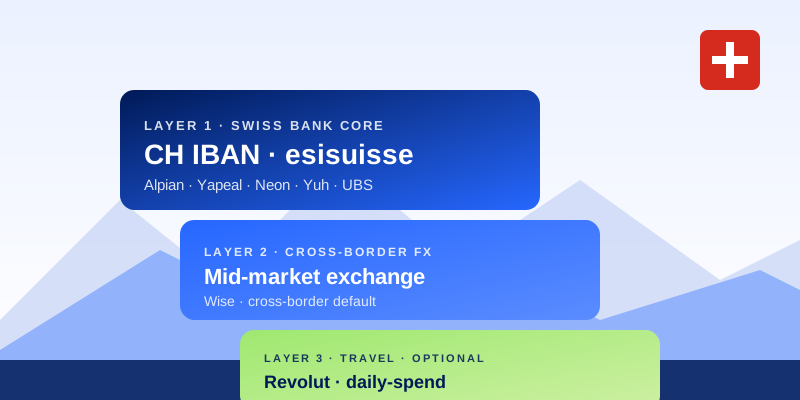
There is no single "best bank for foreigners in Switzerland". There is a best stack of two or three accounts, where each one does what it does best. The CH-IBAN piece is non-negotiable; the cross-border-FX piece almost always is; the travel and investing layers are optional.
For most foreigners who want to open a Swiss bank account as a foreigner today, the strongest single-bank starting points are:
- Alpian: affluent expats with CHF 10k+ savings who want a full FINMA banking licence, esisuisse coverage, and managed investing in one app.
- Yapeal: expats who want a CH-IBAN-first Swiss neobank with a personalised IBAN and an interesting business-account option. Free baseline plan.
- Neon: the cheapest functional Swiss CHF daily account, free baseline, simplest product.
Pair the CH-IBAN account with Wise for cross-border FX, and add Revolut if you travel often. For the full decision framework, see our Alpian vs Revolut vs Wise comparison.
Editorial note. We cover Neon and Yuh as independent editorial coverage; they are not affiliate partners of ours. Their inclusion is for completeness, not commercial.
The one rule every foreigner needs to know
Before any feature, fee, or app comparison, you typically need a CH IBAN. Swiss salary, Krankenkasse direct debit, rental contracts, QR-bill payments and the annual Steuerausweis all run on Swiss-format IBANs. Without one, you will commonly hit Swiss-system friction.
That means the question is not "which is the best bank"; it is "which is the best CH-IBAN-issuing account for my situation". Wise and Revolut do not issue a Swiss IBAN; they are typically not suited as your only account in Switzerland, no matter how strong their FX or travel features are. See our Wise review and Revolut Switzerland review for the deep dives on what each one actually solves.
The CH-IBAN account is your primary financial home. Everything else is a complement. Once you accept that, choosing gets much simpler.
The 5 categories of banking option in Switzerland
Lumping every bank together hides important regulatory differences. Foreigners actually choose between five distinct categories of provider.
- 1
Traditional full-service Swiss banks
UBS, Raiffeisen, PostFinance, cantonal banks (ZKB, BCV, etc.)
- FINMA banking licence + esisuisse coverage up to CHF 100,000 per client per bank.
- Branch network, in-person advisors, every Swiss product including mortgages and Säule 3a.
- Generally higher fees, slower onboarding, less polished mobile apps.
- Often less foreigner-friendly at the entry tier (deposit minimums, document checks).
- 2
New fully-licenced Swiss digital banks
Alpian is the standout current example.
- FINMA banking licence plus esisuisse, the same regulatory tier as legacy banks.
- App-only onboarding, polished UX.
- Managed investing built into the app.
- Multi-currency on a Swiss-licensed bank.
- Premium positioning: not the cheapest, but the most complete Swiss banking experience in a digital-native app.
- 3
Swiss FinTech-licenced neobanks
Yapeal sits here.
- Swiss FinTech licence (not a bank; no esisuisse deposit insurance). Customer funds are safeguarded under the Swiss FinTech regime, a different protection model from a full bank.
- Real CH IBAN, supports QR-bills, Krankenkasse direct debit, all Swiss-system tasks.
- Free baseline plan, Yapeal Private (premium) and Yapeal Business.
- Personalised letter IBAN as a distinctive feature.
- 4
Partner-licenced Swiss neobanks
Neon and Yuh: partner-issued accounts on top of an underlying Swiss-licensed bank.
- CH IBAN issued.
- Aggressively low fees (Neon especially).
- Yuh adds basic investing (fractional shares, crypto), backed by PostFinance and Swissquote.
- Deposit-protection setup depends on the underlying partner bank, so verify in-app for the current arrangement.
- Independent editorial coverage; not affiliate partners of ours.
- 5
Foreign EMIs and EU-passporting fintechs
Wise and Revolut sit here.
- Operate cross-border into Switzerland under foreign authorisations (Wise: NBB Belgium and FCA UK as an EMI; Revolut: Bank of Lithuania under EU passporting).
- No CH IBAN. Wise issues local account details in 40+ currencies, none Swiss; Revolut gives a Lithuanian IBAN by default.
- Not Swiss-licensed, not esisuisse. Wise funds are safeguarded by the home EMI regulator; Revolut deposits sit under the Lithuanian EU Deposit Guarantee Scheme (EUR 100,000), not esisuisse.
- Excellent for specific jobs (cross-border FX, travel-card) but typically not suited as your only Swiss account.
Swiss banking reality check
Two reality checks every foreigner should internalise before signing up for anything.
IBAN reality
A CH-prefixed IBAN is required (or strongly expected) for Swiss salary, Krankenkasse direct debit, rent, QR-bills and the Steuerausweis tax-statement workflow. Foreign IBANs are commonly rejected by Swiss payroll systems and Krankenkasse providers. Wise and Revolut, despite their strengths elsewhere, do not issue a CH IBAN.
Safety reality
Deposit protection in Switzerland comes from one specific scheme, esisuisse, and only applies to deposits at fully-licenced Swiss banks. The categorical picture:
- Full FINMA banking licence + esisuisse (Alpian, UBS, Raiffeisen, PostFinance, cantonal banks): the strongest deposit protection, up to CHF 100k per client per bank.
- Swiss FinTech licence (not a bank; no esisuisse) (Yapeal): customer funds safeguarded under the FinTech regime, a different model from a full bank.
- Partner-licenced (via underlying Swiss bank) (Neon, Yuh): protection inherited from the underlying institution; verify the current arrangement in-app.
- EMI / EU passporting (not Swiss, not esisuisse): Wise (EMI safeguarding under EU/UK home regulators), Revolut (Lithuanian EU Deposit Guarantee Scheme, up to EUR 100,000, not esisuisse).
Rule of thumb among Swiss expats: keep the bulk of large idle savings at a fully-licenced Swiss bank; use the rest for transactional and travel purposes elsewhere.
Top picks ranked by user profile
By user, not by app rating.
-
#1 for Affluent expats
Alpian
Full FINMA banking licence + esisuisse + managed investing in one app. Best fit if you have CHF 10k+ in savings, want a Swiss-resident-focused product, and value depth over absolute cheapness. Open with code PCNC86 at signup for up to CHF 100 in welcome credits (subject to Alpian terms at signup).
-
#2 for Everyday CHF banking with a personalised IBAN
Yapeal
Free baseline plan, real CH IBAN with optional letters, distinct business-account offering. Strong if you are a sole proprietor, GmbH founder or want premium polish without Alpian's price point.
-
#3 for Absolute cheapest CHF daily banking
Neon
Free account, free CHF transfers, very low FX margin on card abroad. Best fit if cost-minimisation is the top priority and you do not need premium features.
-
#4 for Casual CHF + light investing in one app
Yuh
CH IBAN + multi-currency in-app + basic investing (fractional shares, crypto). Backed by PostFinance and Swissquote. Reasonable middle ground for users who want a tiny amount of investing inside the banking app.
-
#5 for Traditional / private-banking style
Legacy Swiss bank
UBS, Raiffeisen, PostFinance, cantonal banks. Pick this if you need mortgages, Säule 3a, in-person advice and an established institutional relationship. Higher fees, slower onboarding, but unmatched institutional depth.
Full comparison table
| Account | Regulatory profile | CH IBAN | esisuisse | Multi-currency | Investing | Best for |
|---|---|---|---|---|---|---|
| Alpian | FINMA banking licence | ✅ | ✅ | 40+ | managed (5 portfolios) | Affluent expats, banking + investing core |
| Yapeal | Swiss FinTech licence (not a bank) | ✅ + personalised | ❌ FinTech safeguarding | basic | ❌ | CH-IBAN-first neobank, sole proprietors |
| Neon | Partner-licenced (Swiss bank in background) | ✅ | via partner, verify in-app | basic | ❌ | Cheapest CHF daily banking |
| Yuh | Partner-licenced (PostFinance + Swissquote) | ✅ | via partner, verify in-app | several | self-directed (basic) | Casual user wanting CHF + light investing |
| Wise | EMI (NBB Belgium + FCA UK) | ❌ (Belgian IBAN for EUR) | ❌ EMI safeguarding | 40+ | ❌ | Cross-border FX at any volume |
| Revolut | EU bank passporting (Lithuania) | ❌ (Lithuanian IBAN by default) | ❌ Lithuanian EU DGS (EUR 100k) | 30+ | self-directed (basic) | Travel-card + daily-spend perks |
| UBS / Raiffeisen / cantonal | FINMA banking licence | ✅ | ✅ | varies | full service | Mortgages, Säule 3a, advisor relationship |
Verify provider-specific details on each company's website; the picture above is accurate as of publication.
By scenario: what to actually open
-
"I just landed in Switzerland and need a bank account now."
Yapeal or Alpian + Wise within first week
App-only onboarding, real CH IBAN within a business day. Add Wise within the first week for moving relocation funds in at mid-market FX.
-
"I have CHF 30k+ in savings and want banking + investing in one app."
Alpian + Wise
Full banking licence + esisuisse on deposits + managed portfolios in the same app. Pair with Wise for cross-border money flow.
-
"I am a cross-border worker paid in EUR."
Wise + Yapeal or Neon
Wise receives your EUR salary at a local Belgian IBAN, converts to CHF at mid-market when needed. The Swiss neobank handles QR-bills and Krankenkasse.
-
"I am a freelancer or running a GmbH."
Yapeal Business + Wise Business
Yapeal Business handles CHF invoicing, QR-bills, MWST, AHV/IV/EO/ALV. Wise Business handles international clients in their currency.
-
"I travel constantly for work."
Revolut Premium / Metal + Swiss neobank (+ Wise)
Revolut for travel insurance + lounge access + daily-spend; the Swiss neobank for salary and Krankenkasse. Add Wise if you transfer money regularly.
-
"I am moving to Switzerland with crypto savings from my home country."
Tangem + Swiss banking option
Hardware self-custody is the safest way to carry crypto across borders. Combine with any of the Swiss banking options above for the fiat side.
Running a freelance practice, Einzelfirma, GmbH or AG? See the dedicated best business account in Switzerland pillar for the full business-side framework (CHF business core + Wise Business + Sperrkonto guidance).
Recommended 2-app and 3-app stacks
If you only want two apps, pick one of these combinations. Each covers most of expat financial life on its own.
Alpian + Wise: best default
Affluent expats. Swiss banking, esisuisse and managed investing on one side; predictable cross-border FX on the other.
Yapeal + Wise: middle-tier default
CH IBAN, free baseline plan and a premium upgrade path; FX done right.
Neon + Wise: cheapest functional stack
Free CHF account; mid-market FX. Skips investing and travel perks.
Revolut + Wise + a Swiss neobank: travel-first stack
Three apps, because Revolut alone or Revolut + Wise cannot cover the CH-IBAN piece.
The full three-app setup adds Revolut on top of the best-default stack for travel coverage. Add Tangem Wallet if you also hold crypto. For the full head-to-head decision framework, see our Alpian vs Revolut vs Wise comparison.
What about UBS, Raiffeisen, PostFinance, cantonal banks?
These are real options, especially if you fall into one of these profiles:
- You will be applying for a Swiss mortgage soon.Hypothek lenders strongly prefer an existing banking relationship at the same institution. A cantonal bank or PostFinance account opened a year before your mortgage application materially smooths the process.
- You want a face-to-face advisor relationship.No digital bank in Switzerland currently offers a true private-banking-style advisory tier accessible from the app store. If you want it, a legacy bank is still the answer.
- You need every Swiss banking product under one roof.Säule 3a, life insurance, mortgages, investment custody, FX and business banking: legacy banks bundle this; digital banks do not.
Where legacy banks underperform: fees. Account maintenance, statement fees, FX margins on international transfers, ATM fees abroad: legacy Swiss banks charge for things that digital banks include free. If your primary need is everyday banking, multi-currency and investing without a mortgage in the next 12 months, the digital options (Alpian, Yapeal, Neon, Yuh) are typically far cheaper.
A common pattern among expats: a digital bank for daily banking plus a small parallel relationship at a legacy bank for the eventual mortgage. Best of both.
Common mistakes foreigners make
- Trying to use Wise or Revolut as the only account They do not issue a CH IBAN; Swiss-system friction (salary, Krankenkasse, rent direct debit) typically appears within weeks.
- Opening a legacy bank account before knowing what you need UBS or PostFinance is fine, but most foreigners arriving today are paying for branch services they will not use. Open a digital bank first; add a legacy bank later if your situation requires it.
- Ignoring the FX layer Bringing relocation funds in via a legacy Swiss bank typically costs 1-3% in invisible FX margin. On CHF 50,000 that is roughly CHF 500-1,500 unnecessarily lost.
- Paying for premium plans before knowing what you use Revolut Premium / Metal, Alpian's paid tier: start on the free baseline, use it for a month, and upgrade only if the paid features genuinely fit your life.
- Storing crypto on an exchange long-term If you arrive with crypto savings, get them into self-custody.
Documents you need to open a Swiss bank account
The exact list varies by provider, but the universal expat checklist:
- Valid passport or national ID (foreign documents accepted by every account in this guide).
- Swiss residency document: Permit B / C / L / G or S, or proof of imminent arrival (employment contract, rental contract).
- Swiss address: even a temporary one for the first month is usually accepted by digital banks; legacy banks may require permanent residence.
- Swiss phone number: required by some providers, optional by others. A foreign number can usually be added afterwards.
- Proof of source of funds: for larger initial deposits, all Swiss-licensed banks ask for documentation under anti-money-laundering rules. A pay slip, employment offer, or sale-of-property contract usually covers it.
Onboarding times typically run
- Digital banks: minutes to a business day.
- Legacy banks: one to four weeks.
- Wise / Revolut: minutes (no Swiss-document gate).
Frequently asked questions
Which is the best bank for foreigners in Switzerland?+
There is no single answer; the best setup is a stack of two or three accounts, each doing what it does best. The strongest starting points are Alpian (affluent), Yapeal (CH-IBAN-first), or Neon (cheapest). All three are commonly paired with Wise for cross-border FX.
Can a foreigner open a bank account in Switzerland?+
Yes. Every digital bank in this guide accepts foreign passports plus a Swiss residency document or proof of imminent arrival. Permit B, C, L, G and S holders can all open accounts. Some accounts can even be opened before relocation using a home-country address.
What is the easiest Swiss bank for expats to open?+
The digital banks. Alpian, Yapeal, Neon and Yuh all run app-based onboarding that typically completes within a business day. Legacy banks (UBS, Raiffeisen, PostFinance) take one to four weeks and require more documents.
Which Swiss bank has the cheapest fees for foreigners?+
Neon for free baseline CHF banking. Yapeal Free is very close. For cross-border transfers, Wise is the cheapest at any volume; pair it with whichever CHF account you choose.
Do I need a CH IBAN to live in Switzerland?+
Effectively yes. Swiss salary, Krankenkasse direct debit, QR-bill payment, rent direct debits, and the annual tax-statement workflow typically run on CH-prefixed IBANs. Wise and Revolut do not issue a CH IBAN, so they are typically not suited as your only Swiss account.
Is Alpian a real Swiss bank?+
Yes. Alpian holds a full FINMA banking licence. Customer deposits are protected by esisuisse up to CHF 100,000 per client per bank.
Is Yapeal safe?+
Yapeal operates under the Swiss FinTech licence (not a bank; no esisuisse). Customer funds are safeguarded under the FinTech regime, which is a different protection model from a full bank. Verify current safeguarding details in-app for larger balances.
Wise vs Revolut for Switzerland: which is better?+
Different jobs. Wise is the predictable cross-border FX layer (always mid-market, no weekend surcharge). Revolut is the travel and daily-spend layer (insurance, cashback, lounges on paid plans). Many expats use both.
Can I receive my Swiss salary on Wise or Revolut?+
Typically not. Foreign IBANs are commonly rejected by Swiss payroll systems, which in most cases require a CH IBAN. Plan to open a Swiss-licensed (or partner-licensed) bank account for salary and use Wise / Revolut alongside.
Is Revolut a Swiss bank?+
No. Revolut operates in Switzerland under EU passporting (via Revolut Bank UAB, a Lithuanian bank). It is not a Swiss-licensed bank. Customer deposits sit under the Lithuanian EU Deposit Guarantee Scheme up to EUR 100,000, not esisuisse.
Should I open a UBS account as a foreigner?+
Only if you have specific needs: mortgage relationship, advisory tier, every Swiss product under one roof. For everyday banking + multi-currency + investing, a digital bank (Alpian, Yapeal, Neon, Yuh) is typically materially cheaper and faster to open.
Can I open a Swiss bank account before I move to Switzerland?+
Some digital banks (notably Wise, which is not Swiss-licensed but available before relocation) can be opened from your home country. Most CH-IBAN-issuing accounts (Alpian, Yapeal, Neon, Yuh) require a Swiss address; you can usually use a temporary first-month address or an employer/landlord-provided address.
Which Swiss bank is best for cross-border workers (Grenzgänger)?+
Wise is typically the strongest tool for receiving EUR salary at a local IBAN and converting to CHF when needed. Pair with a Swiss neobank (Yapeal or Neon) for the small CHF banking footprint you still need locally.
Can Ukrainians in Switzerland open all these accounts?+
Yes. Ukrainian citizens with a Swiss residency document (including Permit S) can open Alpian, Yapeal, Neon, Yuh, Wise and Revolut using their Ukrainian passport and Swiss proof of residence.
Final verdict
The best Swiss bank for expats in 2026 is not one bank; it is the right stack of two or three accounts. The single most important piece is the CH-IBAN account that handles your Swiss life. Around that core, you add cross-border FX, travel perks, and investing as your situation requires.
If you take only one recommendation from this page:
Open a CH-IBAN-issuing Swiss-licensed (or partner-licensed) account first. Alpian if you have real savings and want depth; Yapeal if you want a flexible neobank with free baseline; Neon if cost-minimisation is the only goal. Add Wise within the first month. Add Revolut if you travel often. Add Tangem if you hold crypto. New to the country and unsure about the process? Follow our step-by-step guide to opening a Swiss bank account as a foreigner.
Open the right ones for you
Each affiliate link costs nothing extra and supports our editorial work · disclosure
Published 25 May 2026 · Reviewed & updated 10 June 2026 by bergmoney Research.
Spotted an outdated detail or a regulatory change? Tell us. We update comparison guides quarterly.