
Best business account in Switzerland (2026): the freelancer, GmbH and AG guide
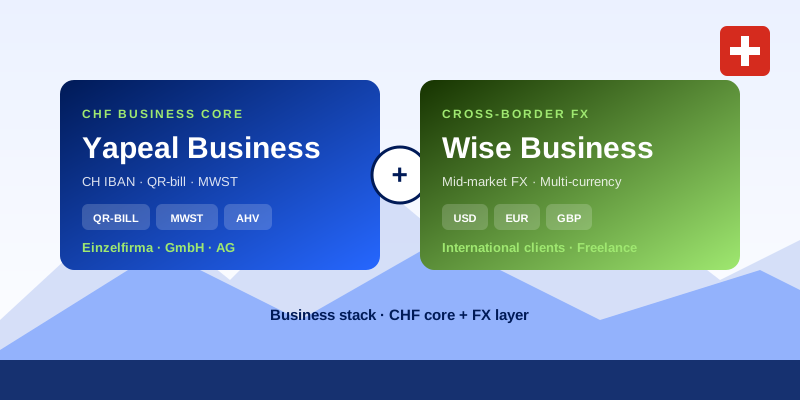
If you are setting up a Swiss freelance practice, a sole proprietorship (Einzelfirma), a GmbH or an AG, the business banking question is not "which one bank do I open?" It is which two accounts do I run side-by-side? Many Swiss expat founders end up running a two-account business setup: a CHF-business core for QR-bills, MWST and payroll, plus a multi-currency layer for international client invoicing.
Published 26 May 2026 · Reviewed & updated 26 May 2026 · By bergmoney Research
Affiliate disclosure: This page links to providers we cover individually. Some of those links are affiliate links (Wise Business, Yapeal Business, Alpian; note Alpian here is the founder's personal companion, not a business account). If you open an account through them we may receive a referral reward at no extra cost to you. Our editorial position is not influenced by referral rewards. read how we make money.
Who this guide is for
This guide is for:
- Freelancers and consultants
- Einzelfirma founders
- GmbH and AG founders (and people forming one)
- Expats and foreigners running a Swiss business
- Businesses with international clients in USD / EUR / GBP
This guide is not for:
- Large corporations needing dedicated treasury desks
- Venture-backed companies with complex multi-jurisdiction financing structures
- Swiss-only retail (consumer) banking comparisons, see our best bank for foreigners in Switzerland personal pillar instead
At a glance
| Your situation | Recommended setup |
|---|---|
| CHF-only freelancer / Einzelfirma | Yapeal Business |
| Freelancer / GmbH with international clients | Wise Business + Yapeal Business |
| Forming a new GmbH | PostFinance Sperrkonto → then Yapeal + Wise stack |
| Forming a new AG | UBS / Raiffeisen Sperrkonto → then operational stack |
| Established AG with complex needs | UBS Geschäftskunden + Wise Business |
| SaaS / e-commerce startup | Stripe + Yapeal Business + Wise Business |
What "best business bank" actually means
When founders search for the best Swiss business bank, the query usually hides one of three intents.
-
"I'm a new Einzelfirma freelancer"
You need a low-friction CHF business account that issues a CH IBAN, handles QR-bills and supports MWST workflow when you cross the registration threshold. The right answer is typically Yapeal Business, with fast onboarding, no minimums and a real CH IBAN.
-
"I have international clients in USD, EUR, GBP"
You need multi-currency receiving with local-format details so clients pay you locally. The right answer is Wise Business as the FX layer, paired with a Swiss-licensed CHF business account.
-
"I'm forming a GmbH or AG"
You first need a Sperrkonto (capital deposit account) at a Swiss-licensed bank to register your company. Then you switch to operational accounts: Yapeal Business + Wise Business stack for most expat founders.
This page is the entry hub.
- Personal-side fintech head-to-head → Wise vs Revolut Switzerland
- Personal-side pillar → best bank for foreigners in Switzerland
- Product deep dives → Wise, Yapeal, Alpian (personal)
Short answer
Many Swiss expat freelancers and founders run a 2-account business setup, not one bank.
- Yapeal Business: Swiss FinTech licence, real CH IBAN, QR-bill native, MWST-friendly statements. Fast app-based onboarding. The default CHF business core for solo founders and small GmbHs.
- Wise Business: safeguarded e-money institution. Multi-currency receiving in 9+ currencies with local-format details. Accounting integrations with Xero, QuickBooks, Sage. The default cross-border layer.
For GmbH and AG formation, Sperrkonto (capital deposit) requires a Swiss-licensed bank, typically PostFinance, UBS, Raiffeisen or a cantonal bank. After registration, founders usually switch operational banking to Yapeal Business + Wise Business.
Founders also typically need a personal layer. See Alpian (full FINMA bank, esisuisse, managed investing) as one option. Not a business account; founder personal-side companion.
Editorial note. We cover PostFinance, UBS, Raiffeisen, cantonal banks, Revolut Business, Stripe, Wallee, N26 Business and Neon Business as independent editorial coverage; they are not affiliate partners of ours.
On this page
- Who this guide is for
- The one rule for Swiss business banking
- Business account vs personal account in Switzerland
- The 5 categories of business banking option
- Swiss business reality check
- How we ranked business accounts
- Top picks by founder profile
- Master comparison table
- By scenario: what to actually open
- When Wise Business may be unnecessary
- When a traditional Swiss bank makes sense
- Cheapest business accounts in Switzerland
- Recommended 2-app and 3-app business stacks
- Sperrkonto specifically (capital deposit)
- Common mistakes founders make
- Documents you need
- FAQ
- Final verdict
The one rule for Swiss business banking
Before any feature comparison, you typically need a CHF business account with a CH IBAN to operate a Swiss business cleanly. Swiss tax (MWST registration), social-security payroll (AHV / IV / EO + BVG + UVG via your local Ausgleichskasse), Krankenkasse for employees, supplier QR-bill payments and the year-end consolidated tax summary all run on CH-prefixed IBANs in practice.
Wise Business is not designed as a Swiss CHF-first business account and typically does not replace a Swiss business IBAN for local Swiss operations. It provides non-Swiss local-format account details (US ACH, UK sort code, EU IBAN, others). Wise Business is excellent at multi-currency receiving and cross-border FX for international clients, but for the Swiss operational core you typically want a Swiss-licensed CHF business account beside it.
The CH-IBAN business account is your operational core. Wise Business is the cross-border layer that sits beside it. For GmbH/AG formation specifically, you also need a Sperrkonto at a Swiss-licensed bank for the capital deposit. See the Sperrkonto section below.
Business account vs personal account in Switzerland
A common founder mistake is treating a personal account as a stand-in for a business account. The line matters in Switzerland for legal, tax and bank-terms reasons.
- Tax and MWSTBusiness income flowing through a personal account creates accounting friction and, once you cross the CHF 100,000 / year MWST registration threshold, makes audits messier. A dedicated business account produces clean, exportable statements that survive the federal MWST workflow.
- Social security (AHV / BVG / UVG)Salary paid to yourself out of a GmbH or AG, and any employee payroll, runs through Swiss CHF transfer forms and reconciles against AHV / IV / EO contributions (via your local Ausgleichskasse) plus BVG and UVG schedules. Smoother through a CHF business account.
- Bank terms of serviceMost personal-account providers (including Wise and Revolut on the personal side) explicitly prohibit using a personal account for business income. The bank can suspend the account for terms violations. Wise Business and Revolut Business exist precisely because of this, so open them separately rather than stretching the personal product.
- QR-bill issuingAs a Swiss business, you typically issue QR-bill invoices to clients. QR-bill payloads reference a business-context CH IBAN; using a personal-account CH IBAN can create friction in clients' accounting and accounts-payable workflows.
For the personal side of your financial life (salary withdrawal, savings, investing), see our best bank for foreigners in Switzerland personal pillar. The business stack and personal stack are deliberately separate.
The 5 categories of business banking option
Foreigners running a Swiss business actually choose between five categories of provider.
- 1
Swiss FinTech-licenced business neobanks
Yapeal Business
Swiss FinTech licence (not a bank; no esisuisse deposit insurance). Funds safeguarded under the FinTech regime. Real CH IBAN, QR-bill native, designed around Swiss-friendly export formats for accounting workflows. App-based onboarding within days. Free or low-cost entry plan. The default CHF business core for solo founders. Verify current feature availability (TWINT compatibility, CAMT-export specifics) for your business profile in-app.
- 2
Cross-border EMI / EU passporting business
Wise Business, Revolut Business, N26 Business, Qonto
Wise Business: safeguarded e-money institution. Multi-currency receiving in 9+ currencies (US ACH, UK sort code, EU IBAN, AUD BSB). Accounting integrations with Xero, QuickBooks, Sage. One-off setup, no monthly subscription. Revolut Business (EU passporting via Lithuania) has expanded Swiss-oriented functionality; verify current support for Swiss IBANs, QR-bills and integrations directly. N26 Business and Qonto: coverage for Swiss residents has fluctuated; verify current onboarding flow on each provider's website. Independent editorial coverage; not affiliate partners except Wise.
- 3
Legacy Swiss banks Geschäftskunden
UBS, PostFinance, Raiffeisen, Migros Bank, ZKB / BCV / kantonal
Full FINMA banking licence + esisuisse. Capital-deposit Sperrkonto (Kapitaleinzahlungskonto) support for GmbH/AG formation. Branch network, advisors, integrated lending. Native QR-bill, CAMT-export, TWINT Business. Higher monthly + per-transaction fees than digital alternatives. Onboarding 1-3 weeks (UBS × NewCo fast-track 24 hours for Sperrkonto). Independent editorial coverage; not affiliate partners of ours.
- 4
Specialised payment platforms (not business banks)
Stripe, Wallee, PostFinance Checkout
Not bank accounts but payment processors that settle to a business bank account (Yapeal Business, PostFinance, UBS). Independent editorial coverage; not affiliate partners.
- 5
Partner-licenced Swiss neobanks (business)
Neon Business
Partner-issued business account on top of an underlying Swiss-licensed bank. CH IBAN, low fees, limited multi-currency. Independent editorial coverage; not affiliate partners.
Swiss business reality check (MWST, AHV, QR-bills, Sperrkonto)
MWST reality
If your business turnover crosses CHF 100,000 per year, MWST (VAT) registration becomes mandatory. Swiss-licensed business accounts (Yapeal Business, PostFinance, UBS, Raiffeisen, Migros Bank) typically integrate with Swiss accounting software (Bexio, Banana, Run my Accounts, Accounto) via Swiss banking export standards (the CAMT / ISO 20022 family is the common reference). Wise Business statements are exportable but typically require more manual reconciliation. Verify current export-format support with each provider for your specific accounting stack.
TWINT Business reality
TWINT is Switzerland's dominant peer-to-peer and merchant payment system. TWINT Business (accepting TWINT at point-of-sale, in invoices, or via QR-display) is more commonly available through Swiss-licensed business accounts (PostFinance, UBS, Raiffeisen, Migros Bank, kantonal). Yapeal Business: TWINT support depends on the provider relationship and business setup, so verify current compatibility with your business profile in-app. Cross-border providers (Wise Business, Revolut Business, N26 Business) typically do not offer native TWINT Business at the merchant tier. For Swiss retail / hospitality / consumer-services businesses, TWINT acceptance is close to expected; for B2B consulting and SaaS, less critical.
AHV / BVG / UVG reality
The moment you pay yourself a salary out of a GmbH or AG, or hire your first employee, you owe regular contributions to AHV / IV / EO (administered through your local Ausgleichskasse), BVG (mandatory occupational pension once salary crosses the threshold), and UVG (mandatory accident insurance). Salary and social-security contributions are easier to reconcile through a Swiss CHF business account. Wise Business can technically execute the CHF transfers, but reconciliation is smoother with a CHF-business core.
QR-bill reality
Swiss invoicing runs on the QR-bill format. Two sides matter:
- Creditor side (issuing invoices): you need a CH IBAN to generate compliant QR-bill payloads. Yapeal Business, PostFinance, UBS support natively. Wise Business support is more limited than Swiss-licensed providers, so verify in-app.
- Debtor side (paying supplier QR-bills): Swiss-licensed apps scan-and-pay natively. Wise Business / cross-border EMIs are more limited, fine for occasional cross-border supplier invoices, friction at volume.
Sperrkonto reality
For GmbH formation: CHF 20,000 share capital deposited into a frozen Sperrkonto (Kapitaleinzahlungskonto). For AG formation: CHF 50,000 minimum cash (CHF 100,000 total share capital). The Sperrkonto must be at a Swiss-licensed bank, typically UBS, PostFinance, Raiffeisen, Migros Bank or a cantonal bank.
Yapeal Business, Wise Business, N26 Business and Revolut Business are not eligible for Sperrkonto. Formation-stage step only.
How we ranked business accounts
We compared Swiss business banking options across a fixed set of dimensions that matter to expat founders specifically:
- CH IBAN availability: required for Swiss CHF operations
- GmbH / AG compatibility: including Sperrkonto eligibility
- QR-bill creditor and debtor side
- TWINT Business compatibility (for retail / hospitality businesses)
- Accounting exports (CAMT / ISO 20022 family for Swiss accounting tools)
- Multi-currency receiving for international clients
- Onboarding speed and document burden
- Monthly cost + per-transaction fees
- Foreign-founder friendliness (Permit B / S / C residency accepted; non-resident edge cases)
- Stack fit: does it work stand-alone or only as part of a 2-account stack
This is editorial ranking based on publicly available provider documentation, Swiss tax and social-security workflow requirements, and direct experience as a Swiss-resident foreign founder. Verify provider-specific details on each company's website before opening, since pricing terms and feature parity change. Where we hold affiliate relationships, this is disclosed at the top of the page and on every CTA.
Top picks by founder profile
By founder profile, not by app rating.
-
#1 for new Einzelfirma / solo freelancer
Yapeal Business
Why we picked it: App-based onboarding within a business day, real CH IBAN, QR-bill native, designed around Swiss accounting workflows, free or low-cost entry plan. Lowest-friction start for a CH-resident solo founder.
Best for: New Einzelfirma, solo freelancers, single-person GmbHs, small consultancies with mostly CHF clients.
Avoid if: You need a Sperrkonto for GmbH / AG formation (Yapeal Business is not eligible, so use a Swiss-licensed bank for that step). You need full FINMA banking licence + esisuisse coverage for large idle balances. You need integrated business lending or merchant acquiring.
Typical stack: Yapeal Business solo (CHF-only) or Yapeal Business + Wise Business (when international clients appear).
-
#2 for international-client freelancer / GmbH
Wise Business
Why we picked it: Multi-currency receiving with local-format details (US ACH for USD clients, UK sort code for GBP, EU IBAN for EUR). Clients pay you locally in their currency; you hold and convert at mid-market when you need CHF. Accounting integrations with Xero, QuickBooks, Sage. One-off setup, no monthly fee.
Best for: Freelancers and consultants invoicing international clients in non-CHF currencies, GmbHs with cross-border revenue, contractor-payout workflows.
Avoid if: All your clients are Swiss and pay in CHF (Wise Business adds no real value, see When Wise Business may be unnecessary below). You need TWINT Business acceptance at the merchant tier. You need a Sperrkonto.
Typical stack: Wise Business + Yapeal Business (CHF core beside cross-border layer).
-
#3 for Sperrkonto (GmbH / AG capital deposit)
PostFinance Geschäftskunden
Why we picked it: Reliable standard route for the Sperrkonto formation step (typically 5-7 business days). Full FINMA banking licence + esisuisse. Reasonable post-formation fees if you keep it as operating bank.
Best for: GmbH founders who want a fast, no-surprises Sperrkonto opening. Founders without a strong preference for a specific Swiss bank brand.
Avoid if: You qualify for UBS × NewCo's 24-hour Sperrkonto fast-track (usually faster). You are forming a multi-shareholder AG (UBS or kantonal tends to be smoother for AG governance).
Typical stack: PostFinance Sperrkonto (formation) → after Handelsregister registration, switch operations to Yapeal Business + Wise Business for lower ongoing cost. Independent editorial coverage; not an affiliate partner.
-
#4 for established GmbH / AG with complex needs
UBS / Raiffeisen Geschäftskunden
Why we picked it: Full advisory tier, integrated business lending, treasury and FX desks, multi-currency at scale, established institutional relationship that opens doors locally.
Best for: Established GmbH / AG with employees and growing balance sheets, founders planning to borrow or take a commercial mortgage, multi-shareholder governance needing formal authority levels, businesses wanting in-person advisory support.
Avoid if: You are a lean solo founder with no lending or treasury needs (you will overpay on monthly + per-transaction fees). You are unwilling to invest the onboarding time (typically 1-3 weeks).
Typical stack: UBS / Raiffeisen Geschäftskunden + Wise Business for cross-border FX. Independent editorial coverage on UBS / Raiffeisen; not affiliate partners.
-
#5 for SaaS / e-commerce with payment processing
Stripe + Yapeal Business stack
Why we picked it: Stripe (or Wallee) handles card-payment processing, settles to a Swiss business bank account. Pairing the settlement target with Yapeal Business gives you CHF processing without burning a monthly base fee.
Best for: SaaS, e-commerce, marketplaces, subscription businesses with card-payment-heavy revenue.
Avoid if: Your business is invoice-based (B2B consulting, custom services), Stripe adds processing-fee overhead with no benefit. You need a traditional merchant-acquiring relationship (legacy Swiss banks often pair better with brick-and-mortar terminal hardware).
Typical stack: Stripe (or Wallee) primary + Yapeal Business CHF settlement + Wise Business for international contractor payouts. Independent editorial coverage on Stripe / Wallee; not affiliate partners.
Master comparison table
| Account | Regulatory profile | CH IBAN | Sperrkonto | Multi-currency | QR-bill | TWINT Business | Swiss accounting export | Free tier | Best for |
|---|---|---|---|---|---|---|---|---|---|
| Yapeal Business | Swiss FinTech licence (not a bank) | ✅ | ❌ | basic | ✅ native | verify in-app | Swiss-friendly exports, verify | ✅ entry plan | CHF business core, freelancer |
| Wise Business | Safeguarded e-money institution | Not Swiss-CHF-first; non-Swiss local-format | ❌ | 9+ local-format | more limited than Swiss-licensed | typically ❌, verify | export to accounting tools | one-off setup, no monthly | International clients, multi-currency |
| PostFinance Geschäftskunden | Full FINMA banking licence | ✅ | ✅ | varies | ✅ native | ✅ | ✅ | monthly fees apply | Sperrkonto + traditional service |
| UBS Geschäftskunden | Full FINMA banking licence | ✅ | ✅ (NewCo fast-track 24h) | full multi-currency | ✅ native | ✅ | ✅ | monthly fees apply | Established GmbH / AG, advisor |
| Raiffeisen Geschäftskunden | Full FINMA banking licence | ✅ | ✅ | several | ✅ native | ✅ | ✅ | monthly fees apply | Regional businesses, mortgage |
| Migros Bank Geschäftskunden | Full FINMA banking licence | ✅ | ✅ | basic | ✅ native | ✅ | ✅ | low monthly fees | Mid-tier solid option |
| Revolut Business | EU bank passporting (Lithuania) | Swiss features vary, verify | ❌ | 25+ | varies, verify | typically ❌, verify | several integrations, verify | varies | International ops, Revolut ecosystem |
| Qonto | EU licensed (France) | varies | ❌ | several | varies, verify | typically ❌ | yes integrations | tier-based | Freelancer / SME / startup |
| Stripe / Wallee (processor, not bank) | Payment processor (PSP) | ❌ settles to other | ❌ | many on charge side | n/a (output side) | n/a | export | API + main accounting | E-commerce / SaaS billing |
N26 Business is covered separately in the 5 categories section; coverage for Swiss residents and Swiss entities has fluctuated historically, so we keep it out of the main comparison table.
Verify provider-specific details on each company's website; pricing and feature parity change.
By scenario: what to actually open
-
"I'm registering an Einzelfirma with mostly CHF local clients."
Yapeal Business solo.
Real CH IBAN within a business day, QR-bill native, free entry plan. Add Wise Business later if even 10% of income becomes foreign.
-
"I'm an Einzelfirma freelancer with 50%+ international clients."
Wise Business + Yapeal Business.
Wise Business gives you US ACH / UK sort code / EU IBAN, so clients pay you locally in their currency. Yapeal Business handles the CHF side (Swiss clients, MWST, AHV).
-
"I'm forming a GmbH."
PostFinance Sperrkonto first → then Yapeal Business + Wise Business stack.
Open the Sperrkonto, deposit CHF 20,000 share capital, get Stampa confirmation for the notary, register at Handelsregister. After registration, you can keep PostFinance as operating bank, or move to the Yapeal Business + Wise Business stack for lower ongoing cost.
-
"I'm forming an AG."
UBS / Raiffeisen Sperrkonto first → then Yapeal Business + Wise Business stack for operations.
AG capital requirement is higher (CHF 100k share capital, CHF 50k minimum cash). Legacy banks tend to be smoother for AG formation than PostFinance. Same post-registration switch logic.
-
"I have an established GmbH that hires."
Yapeal Business + Wise Business + UBS Business (advisor / lending).
Three-account business stack for hiring GmbHs with international exposure. Pair with Alpian on the founder's personal side for salary, savings and managed investing.
-
"I'm a SaaS or e-commerce startup with Stripe."
Stripe primary + Yapeal Business CHF settlement + Wise Business for contractor payouts.
Stripe handles card payments and settles to Yapeal Business. Wise Business pays your international contractors at mid-market FX.
-
"I'm a Grenzgänger who freelances."
Wise Business primary + Yapeal Business secondary.
Cross-border worker → most income is foreign (EUR salary + international freelance USD/EUR). Wise Business is the centre of gravity. Yapeal Business covers the small CHF footprint you still need locally.
-
"I'm a consultant with clients in 5+ countries."
Wise Business + Yapeal Business + Alpian personal.
Wise Business for multi-currency receiving. Yapeal Business for the CHF / MWST / AHV core. Alpian for the founder's personal layer (esisuisse savings, managed investing). PCNC86 code at Alpian signup for the welcome bonus (subject to Alpian terms).
When Wise Business may be unnecessary
The "Wise Business + Yapeal Business" stack is the default for international-facing founders, but not everyone needs it. If nearly all of your clients are in Switzerland and invoice in CHF, a Swiss-only business account may be enough on its own. Examples where Wise Business often adds no real value:
- Local tradespeople (Schreiner, Maler, Elektriker)
- Restaurants and hospitality (CHF revenue + TWINT acceptance is the bigger lever)
- Medical and dental practices with CH-resident patient base
- Local consultants with CH-only client roster
- Property-related businesses (Liegenschaftsverwaltung, local Makler)
In these cases, a Swiss-licensed business account alone (Yapeal Business, or a traditional bank if you also need merchant acquiring / lending) is typically simpler than maintaining a second FX layer.
Open Wise Business only when international invoicing volume justifies the small extra app and reconciliation overhead.
When a traditional Swiss bank makes sense
The "lean stack" (Yapeal Business + Wise Business) is the default for solo founders and small GmbHs. A legacy Swiss bank (UBS, PostFinance, Raiffeisen, Migros Bank, ZKB / BCV / kantonal) becomes more compelling if you:
- Borrow: business loans, working-capital lines, equipment finance, commercial mortgages
- Need merchant acquiring for in-person card-payment processing (Visa / Mastercard)
- Hold larger cash balances that benefit from full FINMA banking licence + esisuisse coverage (CHF 100k per client)
- Need treasury or FX desks for structured hedging beyond what Wise Business does
- Require multiple signatories with formal authority levels (multi-shareholder AG, family-business governance)
- Want in-person advisory support for tax planning, succession, M&A
- Operate in a regional canton where a strong Raiffeisen or kantonal-bank relationship opens doors locally
Many established GmbHs run a parallel two-tier setup: a legacy Swiss bank for the advisor / lending / treasury relationship, and a Yapeal Business + Wise Business stack for lean daily operations.
Cheapest business accounts in Switzerland
For cost-sensitive founders, the cheapest functional Swiss business banking setups today:
- Yapeal Business entry planAmong the cheapest CHF business accounts with a real CH IBAN, native QR-bill and free or low monthly cost. Best for solo Einzelfirma and small GmbHs.
- Wise BusinessOne-off setup fee, then no monthly subscription. Pure per-transaction pricing. Best for international invoicing without paying a monthly base.
- Cross-border alternatives (N26 Business, Qonto)Free or low-cost entry plans, but lack native Swiss-business features (QR-bill creditor, CAMT, TWINT Business). Worth considering if your business is light on Swiss-system tasks.
- PostFinance Geschäftskunden basicModerate monthly fees with full Swiss-bank features; cheaper than UBS for daily ops.
- Migros Bank GeschäftskundenEstablished mid-tier option with competitive monthly pricing.
- UBS / kantonal banksTypically the most expensive of the major options on monthly + per-transaction fees, justified mainly by advisor relationship + lending.
For most solo CH expat founders, a free or near-free 2-account stack (Yapeal Business + Wise Business) covers most needs without burning a monthly subscription.
Recommended 2-app and 3-app business stacks
If you want a minimum-viable business setup, pick one of these stacks. Each covers most Swiss expat freelancer / founder needs.
Yapeal Business + Wise Business → default for most CH expat freelancers and small GmbHs
CHF core + cross-border layer. Both free or low monthly cost.
PostFinance Geschäftskunden + Wise Business → for GmbH founders who want Swiss-bank stability + international flexibility
PostFinance covers Sperrkonto and traditional service; Wise Business handles foreign-client invoicing.
UBS Geschäftskunden + Wise Business → for established AG with multi-currency operations
UBS as the institutional core; Wise Business as the FX layer.
Stripe + Yapeal Business + Wise Business → for SaaS / e-commerce startups
Three-tool stack: payment processor + CHF settlement + cross-border layer.
The personal-side companion, for the founder's salary withdrawal, savings and investing, is typically Alpian (full FINMA bank, esisuisse, managed investing) or a cheaper Swiss neobank (Yapeal Personal, Neon). See the best bank for foreigners in Switzerland pillar for the personal-side framework.
Sperrkonto specifically (capital deposit)
For founders forming a Swiss legal entity, the Sperrkonto (capital deposit account) is a mandatory formation-stage step. Quick mechanics.
- GmbH: CHF 20,000 share capital. Full amount deposited into a Sperrkonto before notary signing of the Statuten and registration at the Handelsregister.
- AG: CHF 100,000 total share capital, of which at least CHF 50,000 paid in cash into the Sperrkonto.
- The account must be at a Swiss-licensed bank. Yapeal Business and Wise Business are not eligible.
Sperrkonto provider options
- UBS Sperrkonto (Kapitaleinzahlungskonto): well-integrated for both GmbH and AG. Standard onboarding typically 1-3 weeks. UBS × NewCo fast-track can issue the Sperrkonto within 24 hours for GmbH formations using the NewCo partner channel, often the fastest route in the market.
- PostFinance Sperrkonto: typically 5-7 business days from application to Stampa confirmation. Reliable standard route.
- Raiffeisen Sperrkonto: regional, typically 1-3 weeks.
- Migros Bank Sperrkonto: established mid-tier option, similar timeline to Raiffeisen.
- Cantonal banks (ZKB, BCV, etc.): vary by canton. ZKB is well-regarded in Zürich.
Costs
Typical Sperrkonto fees average around CHF 250 for setup, with notable variation:
- UBS: often listed as CHF 0 for the Sperrkonto step itself (via UBS × NewCo bundle).
- PostFinance: approximately CHF 145 setup fee.
- Raiffeisen and most cantonal banks: approximately CHF 200-300 setup fee.
Plus a hold fee during the freeze period in some cases. After Handelsregister registration, the Sperrkonto converts to a regular business account. Verify exact current fees with the chosen provider.
What documents the Sperrkonto provider asks for
- Draft Statuten (articles of association, notarised on the founding day, but the bank typically accepts an unsigned draft for opening)
- Stampa declaration template
- Founders' identification: passport / national ID for every founder, signatory and beneficial owner
- Swiss residency document for resident founders (Permit B / C / L / G / S)
- Beneficial-owner declaration (KYC for anyone holding >25% of share capital)
- Address proof for non-resident founders
Once validated, you wire the capital onto the Sperrkonto from any source. The bank issues a Stampa confirmation (Kapitaleinzahlungsbescheinigung) that the notary needs for the founding act.
The typical Sperrkonto-to-operations workflow
- Pick the Sperrkonto provider: UBS (fastest via NewCo fast-track), PostFinance (standard reliable), Raiffeisen / Migros / kantonal (regional preference).
- Open the Sperrkonto: submit documents, wire capital, receive Stampa confirmation. Timeline: 24 hours to 3 weeks.
- Notary founding act: Statuten signed, Stampa confirmation submitted.
- Handelsregister registration: typically 5-15 business days.
- Sperrkonto unfreezes: funds release.
- Choose operational banking: keep the Sperrkonto provider, or switch to a Yapeal Business + Wise Business stack for lower ongoing cost.
Common Sperrkonto pitfalls
- Underestimating timeline: leaving the Sperrkonto application to the last week before the notary appointment is the most common cause of pushed founding dates. Plan 2-3 weeks ahead.
- Wrong bank for entity type: Yapeal Business, Wise Business, N26 Business, Revolut Business are not eligible for Sperrkonto. Confirm provider eligibility.
- Mismatched founder names on transfer: the wire to the Sperrkonto must come from accounts matching the founders' names. Third-party wires often get reversed.
- Forgetting non-cash contributions: if contributing IP or other assets as share capital, a separate Stampa declaration + auditor confirmation is required. Plan with your notary in advance.
Common mistakes founders make
- Using personal Wise or Revolut for business income Tax / MWST reconciliation becomes a mess, AHV compliance is unclear, and the bank can flag the account for business use violating personal terms. Always separate personal and business banking from day one.
- Skipping the Sperrkonto until the last minute Sperrkonto takes 5-21 business days depending on the bank. Founders who realise this two days before notary signing typically delay incorporation by weeks.
- Choosing UBS Business "to look professional" before testing the simpler option UBS Business monthly fees + per-transaction charges add up to CHF 30-50+ per month. For most solo founders, Yapeal Business + Wise Business covers operations for a fraction of the cost.
- Running only one account, no FX layer Paying 1-3% legacy FX margin on every international payment. Adding Wise Business costs nothing and saves real money on the first month of foreign invoicing.
- Mixing personal and business on a single Wise account Accounting nightmare at year-end. Open a Wise Business account separately; the setup is intentionally distinct.
- Not registering MWST when the threshold passes Federal tax penalty risk. Track turnover monthly; register the moment you cross CHF 100,000 / year.
- Routing Stripe / Wallee settlements into a personal CHF account Payment-processor settlements should land in a business account. Tax, MWST and AHV implications.
Documents you need
The exact list varies by provider and entity type.
Einzelfirma (sole proprietorship)
- Valid passport or national ID
- Swiss residency document (Permit B / C / L / G / S)
- AHV number (if already registered)
- Handelsregister excerpt (if Einzelfirma is registered above CHF 100k turnover)
- Proof of business activity (sample invoice, contract, or website)
GmbH / AG forming (Sperrkonto application)
- Notarised Statuten (articles of association)
- Stampa declaration (founders' signatures)
- Auditor or specialist confirmation (where required)
- Beneficial-owner declaration (KYC for all >25% owners)
Already-registered GmbH / AG
- Handelsregister excerpt
- Authorised signatory list
- Beneficial-owner declaration
- Sample invoice / business activity proof
Onboarding timelines
- Yapeal Business: typically 1-3 business days.
- Wise Business: typically 2-5 business days.
- PostFinance Geschäftskunden (Sperrkonto): typically 5-7 business days.
- UBS Geschäftskunden: typically 1-3 weeks.
- Raiffeisen / cantonal: typically 1-3 weeks.
Frequently asked questions
What is the best business bank in Switzerland?+
There is no single answer. Most expat founders need a 2-account business stack. The strongest combinations are Yapeal Business + Wise Business (default for solo founders and small GmbHs), PostFinance Geschäftskunden + Wise Business (for traditional preference + international FX), or UBS Geschäftskunden + Wise Business (for established AG).
Can a foreigner open a business bank account in Switzerland?+
Yes. Permit B, C, L, G and S holders can all open Swiss business accounts. Some providers (especially legacy banks) require more documentation for non-resident founders or recent residents. Digital alternatives (Yapeal Business, Wise Business) are typically faster and less restrictive.
What is the cheapest business account in Switzerland?+
Yapeal Business entry plan is among the cheapest CHF business accounts with a real CH IBAN. Wise Business is one-off setup with no monthly fee, just per-transaction pricing. PostFinance Business is moderate; UBS Business is the most expensive of the major options.
Do I need a Swiss IBAN for my business account?+
Effectively yes for CHF operations. MWST registration, AHV / BVG / UVG payroll, QR-bill creditor side, and year-end consolidated tax summaries typically run on CH IBANs in practice. Foreign IBANs (via Wise Business or Revolut Business) can create reconciliation friction with Swiss accounting and payroll systems. Run a CH-IBAN business account as the operational core.
Can I use Wise as my business account in Switzerland?+
For multi-currency receiving and cross-border transfers, yes, Wise Business is excellent. As your only Swiss business account, typically not. Wise Business is not designed as a Swiss CHF-first business account and typically does not replace a Swiss business IBAN for local operations. QR-bill issuing is more limited compared with Swiss-licensed providers, AHV/BVG reconciliation is awkward, and MWST workflow needs more manual handling. Pair Wise Business with a Swiss-licensed CHF business account.
Is Yapeal Business safe?+
Yapeal operates under the Swiss FinTech licence (not a full banking licence; no esisuisse deposit insurance). Customer funds are safeguarded under the FinTech regime. Different protection model from a fully-licensed Swiss bank. For very large idle balances, transfer to a fully-licensed bank.
Wise Business vs Revolut Business for GmbH?+
Wise Business is typically the default for cross-border invoicing: multi-currency receiving with local-format details, accounting integrations (Xero / QB / Sage), batch payouts. Revolut Business is a separate apply and Swiss availability for Revolut Business has varied, so verify on the Revolut Business website. Usually a fit only if you are already deep in the Revolut Personal ecosystem.
What is a Sperrkonto and do I need one?+
A Sperrkonto is a frozen capital-deposit account required to register a GmbH or AG at the Handelsregister. GmbH: CHF 20,000 deposit. AG: at least CHF 50,000 cash deposit. The Sperrkonto must be at a Swiss-licensed bank, so Yapeal Business and Wise Business are not eligible. Einzelfirma does not need a Sperrkonto.
Can I use Yapeal Business for the Sperrkonto?+
No. Sperrkonto requires a fully-licensed Swiss bank. Use PostFinance (fastest), UBS, Raiffeisen or a cantonal bank for the Sperrkonto step, then switch to Yapeal Business + Wise Business for operating banking after Handelsregister registration.
How long does it take to open a Swiss business account?+
Yapeal Business: typically 1-3 business days. Wise Business: 2-5 business days. PostFinance Sperrkonto: 5-7 business days. UBS / Raiffeisen / cantonal: 1-3 weeks. Plan ahead: Sperrkonto delays are the most common cause of pushed GmbH registration dates.
Which Swiss bank is best for an established GmbH with employees?+
For institutional depth, UBS Geschäftskunden or Raiffeisen Geschäftskunden, with an advisor relationship, integrated lending, multi-currency, treasury services. For lean operations, the Yapeal Business + Wise Business stack covers most needs at a fraction of the monthly cost. Many established GmbHs run both: UBS for advisory + lending, Yapeal Business for daily ops.
Can I receive USD / EUR from international clients?+
Yes, through Wise Business. You get local-format account details across 9+ currencies (US ACH for USD, UK sort code for GBP, EU IBAN for EUR, AUD BSB, others). Clients pay you locally; you hold the currency or convert to CHF at mid-market when you withdraw.
What about MWST workflow and Swiss accounting (CAMT / TWINT)?+
Swiss-licensed business accounts typically integrate cleanly with Swiss accounting software (Bexio, Banana, Run my Accounts, Accounto) via Swiss banking export standards (the CAMT / ISO 20022 family is the common reference) and support TWINT Business at the merchant tier. Cross-border providers (Wise Business, Revolut Business, N26 Business) export in other formats and typically do not offer native TWINT Business, which is workable for low-volume CH operations, friction at higher volumes. Verify current format and TWINT support with each provider for your specific stack.
What about N26 Business and Qonto in Switzerland?+
Both have promoted Swiss-resident onboarding for freelancers and SMEs at various times. Coverage for Swiss residents and Swiss legal entities has fluctuated historically, so verify current onboarding flow on each provider's website. For Swiss-CHF-first operations with native QR-bill and Swiss accounting fit, Yapeal Business is typically the stronger choice. Independent editorial coverage; not affiliate partners.
Can Ukrainians in Switzerland open Swiss business accounts?+
Yes. Ukrainian citizens with a Swiss residency document (including Permit S) can register an Einzelfirma or form a GmbH in Switzerland, and open business accounts at Yapeal Business, Wise Business, PostFinance, UBS, Raiffeisen and cantonal banks. Documentation requirements are standard.
Final verdict
The best business account in Switzerland is not one account. It is the right 2-account stack for your founder profile.
- For solo Einzelfirma and small GmbH: Yapeal Business + Wise Business. Default stack. Covers CHF core (QR-bills, MWST, AHV) and cross-border invoicing.
- For GmbH / AG formation: Open a Sperrkonto at PostFinance (or UBS / Raiffeisen for AG), deposit capital, register at Handelsregister, then switch operational banking to Yapeal Business + Wise Business.
- For established AG with complex needs: UBS Geschäftskunden + Wise Business. Advisor relationship + cross-border layer.
- For SaaS / e-commerce: Stripe (or Wallee) + Yapeal Business + Wise Business. Three-tool stack.
For the founder's personal layer (salary withdrawal, savings, investing): Alpian is one strong option for founders who want full FINMA banking + esisuisse coverage + managed investing in one app. See also the best bank for foreigners in Switzerland personal pillar for the full set of personal-side options. Use code PCNC86 at Alpian signup for the welcome bonus (subject to Alpian terms). Alpian is not a business account; it is one founder personal-side option.
Open the right ones for you
Each affiliate link costs nothing extra and supports our editorial work · disclosure
Published 26 May 2026 · Reviewed & updated 26 May 2026 by bergmoney Research.
Spotted an outdated detail or a regulatory change? Tell us. We update comparison guides quarterly.